

Höre diesen Podcast kostenlos in der App: Kostenlos im App Store laden
radio.de
Sleeptimer
Sender speichern
371 Episoden
Healthy Living Your Way: Autism, Movement & Rest with Jimmy Clare
14.10.2026 | 35 Min.What if healthy living did not require following the latest trend, tolerating someone else's workout music, or pretending every day comes with the same amount of energy?
In this episode of Adulting with Autism, I talk with Jimmy Clare, an autistic keynote speaker, autism advocate, podcaster, livestream host, and founder of CrazyFitnessGuy. He created the platform to share healthy living through autistic eyes, with an emphasis on practical support rather than pressure or perfection.:not([hidden])~:not([hidden]))]:border-soft bg-soft">crazyfitnessguy+1
Jimmy shares how exercise became part of his response to years of bullying, why sensory details matter in movement, and how he uses reminders, distraction blockers, and his most productive hours to structure his work.
He also gets honest about what he has not figured out yet: adapting to pain, changing capacity, medication side effects, and difficult days. We discuss reducing expectations when you are unwell, finding enjoyable activities, communicating concerns to healthcare professionals, and stepping away from comparison.
Jimmy speaks from lived experience—not as a certified fitness professional. This episode explores his personal approach to wellness, not an exercise prescription or individualized medical advice.
In This Episode, We Cover
p]:pt-0 [&>p]:mb-2 [&>p]:my-0"> Jimmy's work as a speaker, advocate, podcast host, and founder of CrazyFitnessGuy.
p]:pt-0 [&>p]:mb-2 [&>p]:my-0"> How years of bullying shaped his relationship with exercise, stress, and belonging.
p]:pt-0 [&>p]:mb-2 [&>p]:my-0"> What "healthy living your way" means to him.
p]:pt-0 [&>p]:mb-2 [&>p]:my-0"> Why one exercise modification may not meet everyone's needs.
p]:pt-0 [&>p]:mb-2 [&>p]:my-0"> His approach to trying products before endorsing them.
p]:pt-0 [&>p]:mb-2 [&>p]:my-0"> To-do apps, persistent reminders, and reducing reliance on other people's prompts.
p]:pt-0 [&>p]:mb-2 [&>p]:my-0"> Blocking distracting websites during his most productive hours.
p]:pt-0 [&>p]:mb-2 [&>p]:my-0"> Designing a workspace around attention rather than other people's preferences.
p]:pt-0 [&>p]:mb-2 [&>p]:my-0"> Why Jimmy prefers control over workout music and volume.
p]:pt-0 [&>p]:mb-2 [&>p]:my-0"> Adapting routines while dealing with a protruding disc and fluctuating wellbeing.
p]:pt-0 [&>p]:mb-2 [&>p]:my-0"> His prediction about AI and personalized fitness—and the distinction between speculation and current professional guidance.
p]:pt-0 [&>p]:mb-2 [&>p]:my-0"> Why he separates lived-experience advice from fitness qualifications.
p]:pt-0 [&>p]:mb-2 [&>p]:my-0"> Recording symptoms and communicating with clinicians through patient portals.
p]:pt-0 [&>p]:mb-2 [&>p]:my-0"> Convenience, food planning, and the tools he personally uses.
p]:pt-0 [&>p]:mb-2 [&>p]:my-0"> Reducing a difficult day to one manageable priority.
p]:pt-0 [&>p]:mb-2 [&>p]:my-0"> Why rest does not need to be earned through constant productivity.
p]:pt-0 [&>p]:mb-2 [&>p]:my-0"> Learning from podcast guests without assuming every suggestion applies to him.
p]:pt-0 [&>p]:mb-2 [&>p]:my-0"> Starting with activities you enjoy.
p]:pt-0 [&>p]:mb-2 [&>p]:my-0"> Replacing business comparison with attention to his own progress.
About the Guest
Jimmy Clare is an autistic professional keynote speaker, autism advocate, podcaster, and livestream host. He founded CrazyFitnessGuy in 2017 to share healthy living through autistic eyes and encourage sustainable habits rooted in lived experience.
Through his platform and The CrazyFitnessGuy Show, he explores autism, sensory needs, routines, mental health, burnout, and everyday wellbeing. His speaking work addresses inclusion, resilience, and realistic self-care.:not([hidden])~:not([hidden]))]:border-soft bg-soft">jimmyclarespeaks+1
In this interview, Jimmy explicitly states that he is not a certified fitness professional or personal trainer. His contribution is his own experience of finding tools and approaches that work for him.
Resources:
p]:pt-0 [&>p]:mb-2 [&>p]:my-0"> CrazyFitnessGuy: podcast and wellness resources.crazyfitnessguy
p]:pt-0 [&>p]:mb-2 [&>p]:my-0"> Jimmy Clare's speaking services.jimmyclarespeaks
Key Takeaways
p]:pt-0 [&>p]:mb-2 [&>p]:my-0"> A wellness routine can account for sensory preferences, access, enjoyment, and changing capacity.
p]:pt-0 [&>p]:mb-2 [&>p]:my-0"> A tool that helps one person is an option to explore—not a rule for everyone.
p]:pt-0 [&>p]:mb-2 [&>p]:my-0"> Jimmy's routine includes reducing distractions and matching demanding work to his better-focus hours.
p]:pt-0 [&>p]:mb-2 [&>p]:my-0"> He does not present himself as having every difficult day figured out.
p]:pt-0 [&>p]:mb-2 [&>p]:my-0"> Rest can be part of looking after yourself rather than a prize awarded after completing a task list.
p]:pt-0 [&>p]:mb-2 [&>p]:my-0"> Sharing lived experience and providing professional exercise or medical guidance are different roles.
p]:pt-0 [&>p]:mb-2 [&>p]:my-0"> Comparison can become another demand that takes attention away from your own needs and progress.Throwback Tuesday: Professor Sol Smith on Autism, Unmasking & Self-Discovery
13.10.2026 | 48 Min.Hey squad—it's Throwback Tuesday.
Monday came, I was exhausted, and I decided not to force an episode when my brain had already clocked out. Instead, we're revisiting a conversation many of you will appreciate after Professor Sol Smith's recent return to the podcast: his very first interview on Adulting with Autism.
In this original conversation, Sol discusses his journey to an autism diagnosis, his experience as a college professor, and the thinking behind The Autistic's Guide to Self-Discovery. We explore masking, rumination, burnout, individualized support, community, and the question so many late-identified autistic adults face: "Now that I understand this about myself, what happens next?"paste.txt
We also talk about supporting strengths instead of spending every moment correcting weaknesses, how parents can move from guilt toward repair, and why special interests can open unexpected doors to confidence and connection. Sol shares a memorable story about his child discovering speedcubing—and how that interest became a pathway into a supportive community.paste.txt
If you enjoyed his recent episode about ADHD self-discovery, this is your chance to hear where our conversation began.
Grab your drink of choice—absolutely no judgment—and welcome back Professor Sol.
Archive note: This is a replay of an earlier interview. References to ages, book-release timing, community offerings, and personal circumstances reflect when the original conversation was recorded.
In This Episode
p]:pt-0 [&>p]:mb-2 [&>p]:my-0"> Why a clearly defined teaching role felt more comfortable for Sol than unstructured social interaction.
p]:pt-0 [&>p]:mb-2 [&>p]:my-0"> His path to an autism assessment and the assumptions he had about what an autistic adult could look like.
p]:pt-0 [&>p]:mb-2 [&>p]:my-0"> Why "we're all a little autistic" can miss the meaning of the autism spectrum.
p]:pt-0 [&>p]:mb-2 [&>p]:my-0"> How rumination can feel like solving a problem while repeatedly returning to a painful experience.
p]:pt-0 [&>p]:mb-2 [&>p]:my-0"> Sol's discussion of immediate coping tools and longer-term support.
p]:pt-0 [&>p]:mb-2 [&>p]:my-0"> Why he wanted to create a self-discovery roadmap for late-identified autistic adults.
p]:pt-0 [&>p]:mb-2 [&>p]:my-0"> The gap between receiving a diagnosis and finding useful adult support.
p]:pt-0 [&>p]:mb-2 [&>p]:my-0"> Why individualized support matters when strengths and difficulties are uneven.
p]:pt-0 [&>p]:mb-2 [&>p]:my-0"> Coaching that responds to the person rather than following a fixed weekly formula.
p]:pt-0 [&>p]:mb-2 [&>p]:my-0"> Seeking help with draining tasks while making more room for strengths.
p]:pt-0 [&>p]:mb-2 [&>p]:my-0"> The importance of cultural fit, access, and recognizing that one coach will not suit everyone.
p]:pt-0 [&>p]:mb-2 [&>p]:my-0"> Community as a place to explore identity, unmasking, and belonging.
p]:pt-0 [&>p]:mb-2 [&>p]:my-0"> Why autism education should involve people around autistic adults—not only autistic adults themselves.
p]:pt-0 [&>p]:mb-2 [&>p]:my-0"> Moving beyond parental guilt toward accountability and changed support.
p]:pt-0 [&>p]:mb-2 [&>p]:my-0"> Sol's family story about speedcubing, friendship, confidence, and special interests.paste.txt
About Professor Sol
Sol Smith is an autistic and ADHD coach, author, and educator. In this first interview, he shares his experience as a longtime college professor, his late autism diagnosis, and his work creating resources for autistic self-understanding.
His book, The Autistic's Guide to Self-Discovery, is the focus of this archive conversation. He also discusses individualized coaching and the Neurospicy Community, which he developed as a more accessible way for people to find support and connection.
You can direct listeners to the resource links included with his recent return episode for updated information about his books, coaching, and community.
Key Takeaways
p]:pt-0 [&>p]:mb-2 [&>p]:my-0"> A clear role can make one kind of social interaction feel very different from another.
p]:pt-0 [&>p]:mb-2 [&>p]:my-0"> A diagnosis can provide context without automatically supplying the support someone needs next.
p]:pt-0 [&>p]:mb-2 [&>p]:my-0"> Repeatedly revisiting a painful event is not always the same as making progress on it.
p]:pt-0 [&>p]:mb-2 [&>p]:my-0"> Support should respond to a person's actual strengths, needs, circumstances, and preferences.
p]:pt-0 [&>p]:mb-2 [&>p]:my-0"> Needing help with one area of life does not erase competence in another.
p]:pt-0 [&>p]:mb-2 [&>p]:my-0"> Parents can acknowledge what they did not understand and change how they support their child now.
p]:pt-0 [&>p]:mb-2 [&>p]:my-0"> Special interests can be meaningful routes into connection—not simply distractions to remove.
p]:pt-0 [&>p]:mb-2 [&>p]:my-0"> Self-discovery does not have to happen alone.Your Degree Wasn't a Waste: Career Pivots & Transferable Skills
10.10.2026 | 21 Min.The promotions were there. The pay was good. The team was successful.
So why didn't it feel like success?
In this episode of Adulting with Autism, I talk with executive coach and author Chad Betz about the moment he sat in a parking garage after work and realized that the life he had built no longer matched what success meant to him.
We explore the difference between pursuing something you genuinely want and following expectations inherited from family, coworkers, social media, or an earlier version of yourself. Chad shares how informational interviews, small experiments, trusted support, and reflection can help you explore a new direction without immediately quitting your job or taking on another degree.
For autistic, ADHD, and other neurodivergent adults reassessing life after late identification, this conversation makes room for an important possibility: learning more about yourself can change your goals—and changing direction does not erase everything you have already accomplished.
We also discuss Chad's 20-goal exercise, his use of the OODA loop—Observe, Orient, Decide, Act—and why coaching should help you identify your own direction rather than hand you another person's definition of success.
In This Episode, We Cover
p]:pt-0 [&>p]:mb-2 [&>p]:my-0"> Chad's parking-garage realization: professional achievement did not automatically create personal fulfillment.
p]:pt-0 [&>p]:mb-2 [&>p]:my-0"> The shift from reacting to circumstances toward identifying choices within his control.
p]:pt-0 [&>p]:mb-2 [&>p]:my-0"> Why success does not have to happen by a particular age.
p]:pt-0 [&>p]:mb-2 [&>p]:my-0"> How experience can provide useful skills while also making it harder to change direction.
p]:pt-0 [&>p]:mb-2 [&>p]:my-0"> Exploring whether difficult work still connects with your sense of purpose.
p]:pt-0 [&>p]:mb-2 [&>p]:my-0"> Why leaving a field does not mean your education and experience were wasted.
p]:pt-0 [&>p]:mb-2 [&>p]:my-0"> A criminal-justice graduate's exploration of banking, legal support, and alternative career paths.
p]:pt-0 [&>p]:mb-2 [&>p]:my-0"> Informational interviews: learning what a role actually involves before committing.
p]:pt-0 [&>p]:mb-2 [&>p]:my-0"> Coaches, mentors, and trusted advisers as outside perspectives.
p]:pt-0 [&>p]:mb-2 [&>p]:my-0"> Testing an idea through a hobby, volunteer opportunity, or side project.
p]:pt-0 [&>p]:mb-2 [&>p]:my-0"> Fear of uncertainty versus the feeling that leaving means losing your past investment.
p]:pt-0 [&>p]:mb-2 [&>p]:my-0"> Building confidence through manageable action and learning.
p]:pt-0 [&>p]:mb-2 [&>p]:my-0"> Coaching that draws out your goals instead of imposing new ones.
p]:pt-0 [&>p]:mb-2 [&>p]:my-0"> The 20-goal exercise: identifying recurring interests and priorities.
p]:pt-0 [&>p]:mb-2 [&>p]:my-0"> Reassessing work after learning something significant about yourself.
p]:pt-0 [&>p]:mb-2 [&>p]:my-0"> Distinguishing genuine ambition from pressure to prove yourself.
p]:pt-0 [&>p]:mb-2 [&>p]:my-0"> Why protection and support are not always the same thing.
p]:pt-0 [&>p]:mb-2 [&>p]:my-0"> Accountability, habits, and giving yourself room for difficult days.
p]:pt-0 [&>p]:mb-2 [&>p]:my-0"> Using Observe, Orient, Decide, Act to revisit your direction.
p]:pt-0 [&>p]:mb-2 [&>p]:my-0"> Questions to ask before accepting a promotion or new responsibility.
p]:pt-0 [&>p]:mb-2 [&>p]:my-0"> Allowing your definition of success to evolve.
About the Guest
Chad Betz is an executive coach and author who helps people explore success that is personally meaningful to them. He works with individuals who feel stuck, uncertain about their next step, or disconnected from a career that may appear successful from the outside.
In this episode, Chad shares how his own professional dissatisfaction led him to reconsider his values, goals, and relationship with work. His approach emphasizes reflection, practical exploration, informational interviews, and small steps toward change.
Find Chad's coaching information, books, social links, and free content through the website he names in the interview: An Authentic Success.
Publishing note: The spoken website address sounds like "an authentic success dot com." Confirm the exact URL with Chad before adding a clickable link. The transcript also does not identify a specific book title.
Key Takeaways
p]:pt-0 [&>p]:mb-2 [&>p]:my-0"> External achievement and personal fulfillment are not necessarily the same thing.
p]:pt-0 [&>p]:mb-2 [&>p]:my-0"> Your education and experience remain part of your skill set even if you change direction.
p]:pt-0 [&>p]:mb-2 [&>p]:my-0"> A new chapter can begin with an experiment—not an immediate resignation.
p]:pt-0 [&>p]:mb-2 [&>p]:my-0"> Informational interviews can help replace an imagined career with a clearer picture of daily work.
p]:pt-0 [&>p]:mb-2 [&>p]:my-0"> Coaching should support your choices rather than create another set of expectations to satisfy.
p]:pt-0 [&>p]:mb-2 [&>p]:my-0"> Confidence can grow through small actions; it does not have to arrive before you begin.
p]:pt-0 [&>p]:mb-2 [&>p]:my-0"> A promotion deserves evaluation, not automatic acceptance.
p]:pt-0 [&>p]:mb-2 [&>p]:my-0"> Your goals can change as your needs, priorities, and self-understanding change.
p]:pt-0 [&>p]:mb-2 [&>p]:my-0"> A hard period is a reason to investigate—not proof that your whole career was a mistake.Different Brains, Better Systems: Rethinking Normal with Nat Hawley
07.10.2026 | 31 Min.A company can celebrate neurodiversity, hire neurodivergent employees, and still create a workplace where those employees burn out trying to stay.
So what does inclusion look like after the interview?
In this episode of Adulting with Autism, I talk with Nat Hawley, founder of Divergent Thinking, a UK-based workplace neuroinclusion consultancy. Nat combines lived experience of autism, dyslexia, and dyspraxia with professional experience and a master's degree in applied neuroscience. His organization supports workplaces through training, coaching, needs assessments, and reviews of recruitment, communication, policies, and everyday practice.divergentthinking
We discuss the difference between awareness and embedded inclusion, why accessible recruitment must lead to sustainable employment, and how workplaces can remove unnecessary barriers before employees have to ask.
Nat also shares a practical approach to feedback: describe what happened, avoid assuming the worst, explain the impact, and work together on a way forward. We explore disclosure as a personal decision, asking for support, workplace needs passports, and why promotion should recognize results—not require everyone to follow one narrow path.
This episode is for neurodivergent employees, job seekers, managers, HR teams, parents supporting young adults, and anyone tired of hearing "read the room" instead of receiving clear instructions.
In this episode
p]:pt-0 [&>p]:mb-2 [&>p]:my-0"> Nat's journey from understanding himself through limitations to recognizing his strengths.
p]:pt-0 [&>p]:mb-2 [&>p]:my-0"> Combining lived experience, professional practice, and neuroscience.
p]:pt-0 [&>p]:mb-2 [&>p]:my-0"> Universal design: starting with how people work rather than requiring people to fit existing processes.
p]:pt-0 [&>p]:mb-2 [&>p]:my-0"> Why celebrating neurodiversity is different from embedding inclusion into everyday decisions.
p]:pt-0 [&>p]:mb-2 [&>p]:my-0"> Moving from reactive support toward proactive, sustainable workplace practices.
p]:pt-0 [&>p]:mb-2 [&>p]:my-0"> The difference between getting someone hired and helping them stay without exhausting themselves.
p]:pt-0 [&>p]:mb-2 [&>p]:my-0"> Recruitment processes that reward familiarity and social performance rather than revealing talent.
p]:pt-0 [&>p]:mb-2 [&>p]:my-0"> Written communication, quiet spaces, and accessible onboarding as everyday design choices.
p]:pt-0 [&>p]:mb-2 [&>p]:my-0"> Checking staffing, training, workload, and time expectations before blaming an employee.
p]:pt-0 [&>p]:mb-2 [&>p]:my-0"> Questions job seekers can ask about policies, employee networks, and leadership.
p]:pt-0 [&>p]:mb-2 [&>p]:my-0"> Nat's explanation of double empathy as a two-way effort to understand different communication styles.
p]:pt-0 [&>p]:mb-2 [&>p]:my-0"> Why "be more proactive," "it's obvious," and "read the room" can leave employees guessing.
p]:pt-0 [&>p]:mb-2 [&>p]:my-0"> A feedback approach built around observation, impact, curiosity, and collaboration.
p]:pt-0 [&>p]:mb-2 [&>p]:my-0"> Framing support requests around what helps you contribute effectively.
p]:pt-0 [&>p]:mb-2 [&>p]:my-0"> Why disclosure is personal—not a requirement to become the office's neurodiversity spokesperson.
p]:pt-0 [&>p]:mb-2 [&>p]:my-0"> Workplace needs assessments and passports as ways to document practical support.
p]:pt-0 [&>p]:mb-2 [&>p]:my-0"> Recognizing when repeated unmet needs may indicate a workplace mismatch.
p]:pt-0 [&>p]:mb-2 [&>p]:my-0"> Career progression through different methods, including assistive technology.
p]:pt-0 [&>p]:mb-2 [&>p]:my-0"> Nat's example of using audio to improve his understanding and retention of written material.
About Nat Hawley
Nat Hawley is the founder of Divergent Thinking, a UK-based workplace neuroinclusion consultancy. In this conversation, he shares his lived experience of autism, dyslexia, and dyspraxia and describes a decade of supporting neurodivergent people with employment, purpose, and self-understanding.
A TEDx speaker with an MSc in Applied Neuroscience, Nat brings together personal experience and workplace expertise. Divergent Thinking offers consultancy, workplace needs assessments, strengths-based coaching, audits, manager training, workshops, and speaking services.divergentthinking
Find Nat's resources, training, coaching, workshops, and contact information at divergentthinking.uk—not ".co.uk."divergentthinking
Key takeaways
p]:pt-0 [&>p]:mb-2 [&>p]:my-0"> An accessible interview is a beginning, not the end of inclusion.
p]:pt-0 [&>p]:mb-2 [&>p]:my-0"> Sustainable employment matters as much as recruitment.
p]:pt-0 [&>p]:mb-2 [&>p]:my-0"> Before judging performance, investigate the instructions, training, workload, environment, and available support.
p]:pt-0 [&>p]:mb-2 [&>p]:my-0"> Clear feedback describes behavior and impact rather than assigning a negative personality label.
p]:pt-0 [&>p]:mb-2 [&>p]:my-0"> Understanding communication differences should be a shared effort.
p]:pt-0 [&>p]:mb-2 [&>p]:my-0"> People can discuss work preferences without making their whole identity available for public discussion.
p]:pt-0 [&>p]:mb-2 [&>p]:my-0"> Different methods can lead to the same valuable outcome.
p]:pt-0 [&>p]:mb-2 [&>p]:my-0"> Workplace inclusion should be built into everyday systems—not restarted every awareness week.What Works for Your Brain? Personal Science with Gary Wolf
05.10.2026 | 27 Min.What if understanding your energy, attention, and daily struggles does not require another expensive wearable—or tracking every 15 minutes of your life?
In this episode of Adulting with Autism, I talk with science writer Gary Wolf, co-founder of the Quantified Self movement and author of The Quantified Self: Learning to Observe. His work explores how people can use their own observations and data to answer questions that matter in their everyday lives.:not([hidden])~:not([hidden]))]:border-soft bg-soft">workman+1
We discuss how to start with one concrete question: Do I have energy left after work? When do I crash? What makes me late? What helps me recover?
Gary explains why personal observations matter, how wearables can provide context without telling the whole story, and why an experiment that does not work is information—not proof that you failed. We also walk through my hypothetical work-crash pattern and explore how to investigate it without immediately turning my entire life upside down.
This conversation is for autistic, ADHD, and neurodivergent adults who want to understand themselves without creating another overwhelming productivity system.
In this episode
p]:pt-0 [&>p]:mb-2 [&>p]:my-0"> How a gathering organized by Gary and Kevin Kelly became a worldwide self-research community.
p]:pt-0 [&>p]:mb-2 [&>p]:my-0"> The three Quantified Self show-and-tell questions: "What did I do? How did I do it? What did I learn?"
p]:pt-0 [&>p]:mb-2 [&>p]:my-0"> Why tracking attention or energy does not have to mean recording every moment.
p]:pt-0 [&>p]:mb-2 [&>p]:my-0"> Starting with one daily observation rather than a complicated dashboard.
p]:pt-0 [&>p]:mb-2 [&>p]:my-0"> Gary's practical starting suggestion of approximately six weeks of daily observations—not a universal threshold for proving a result.
p]:pt-0 [&>p]:mb-2 [&>p]:my-0"> Why "I had energy left after work" is a meaningful observation.
p]:pt-0 [&>p]:mb-2 [&>p]:my-0"> Refining vague measures into something easier to notice.
p]:pt-0 [&>p]:mb-2 [&>p]:my-0"> Investigating specific difficulties instead of trying to measure "executive function" as one giant concept.
p]:pt-0 [&>p]:mb-2 [&>p]:my-0"> Foreground data: the question or experience you actually care about.
p]:pt-0 [&>p]:mb-2 [&>p]:my-0"> Background data: context from wearables, calendars, messages, and other existing records.
p]:pt-0 [&>p]:mb-2 [&>p]:my-0"> The difference between noticing a useful personal pattern and proving an intervention works for everyone.
p]:pt-0 [&>p]:mb-2 [&>p]:my-0"> When tracking becomes more burdensome than useful.
p]:pt-0 [&>p]:mb-2 [&>p]:my-0"> The role of clinician collaboration when questions involve symptoms, medication, or health decisions.
p]:pt-0 [&>p]:mb-2 [&>p]:my-0"> April's hypothetical question: "Why do I crash every third workday?"
p]:pt-0 [&>p]:mb-2 [&>p]:my-0"> Observing a pattern before choosing a change.
p]:pt-0 [&>p]:mb-2 [&>p]:my-0"> Using what you learn to select a small, relevant experiment.
p]:pt-0 [&>p]:mb-2 [&>p]:my-0"> Why curiosity can help replace the story "This system failed, so I'm a failure."
p]:pt-0 [&>p]:mb-2 [&>p]:my-0"> Learning from other people's self-research without assuming their solution will fit your life.
About Gary
Gary Wolf is a science and technology writer based in Berkeley, California. A former executive editor of Wired Digital and contributing editor at Wired, he co-founded the Quantified Self movement in 2008.workman
He now works with the Personal Science Research Group to develop methods, tools, and case studies that support small-scale empirical research. His book, The Quantified Self: Learning to Observe, brings together personal stories and scientific reasoning methods for exploring questions about mood, cognition, sleep, pain, digestion, and other areas of life.:not([hidden])~:not([hidden]))]:border-soft bg-soft">workman+1
Resources:
p]:pt-0 [&>p]:mb-2 [&>p]:my-0"> Gary's website.antephase
p]:pt-0 [&>p]:mb-2 [&>p]:my-0"> Quantified Self and book information.quantifiedself
p]:pt-0 [&>p]:mb-2 [&>p]:my-0"> Publisher's book page.workman
Release note: The publisher lists October 6, 2026, as the book's release date. Use "available for preorder" if the episode publishes before then, and "available now" afterward.workman
Key takeaways
p]:pt-0 [&>p]:mb-2 [&>p]:my-0"> Start with a question that matters to you—not whatever your device happens to measure.
p]:pt-0 [&>p]:mb-2 [&>p]:my-0"> One useful observation can be more manageable than a complicated tracking system.
p]:pt-0 [&>p]:mb-2 [&>p]:my-0"> Your experience belongs in the picture; a wearable score is not the whole story.
p]:pt-0 [&>p]:mb-2 [&>p]:my-0"> Personal patterns can guide questions and decisions without establishing universal cause and effect.
p]:pt-0 [&>p]:mb-2 [&>p]:my-0"> Tracking should serve your life. Reassess when its burden exceeds its usefulness.
p]:pt-0 [&>p]:mb-2 [&>p]:my-0"> An unsuccessful experiment can still teach you something.
p]:pt-0 [&>p]:mb-2 [&>p]:my-0"> Health-related tracking can support a clinical conversation; it is not a substitute for medical evaluation or guidance on medication changes.
Weitere Bildung Podcasts









Trending Bildung Podcasts



















Über Adulting with Autism
ADULTING WITH AUTISM
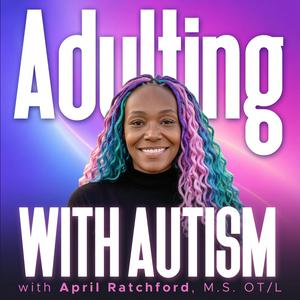
A movement for neurodivergent adults, created by autistic occupational therapist April Ratchford, OTR/L.
Adulting with Autism is a global community for autistic and ADHD adults navigating independence, relationships, college life, careers, emotional regulation, and real-world executive-function challenges. With over 2.7 million downloads, April blends lived experience, clinical insight, and honest conversation to guide neurodivergent adults into their next chapter of growth.
Each episode brings practical tools, mental-health strategies, autistic storytelling, and real talk about boundaries, burnout, sensory needs, finances, friendships, and the messy parts of becoming an independent adult.
Featuring leading experts in autism, mental health, neuroscience, accessibility, and creative industries — along with deeply human stories from autistic adults around the world.
If you're a late-diagnosed autistic adult, a college student trying to survive executive-function chaos, or a neurodivergent person trying to build a life that actually fits — you are in the right place.
🎙️ Hosted by:
April Ratchford, OTR/L — autistic occupational therapist, autism advocate, author, and executive contributor to Brainz Magazine.
Podcast-WebsiteHöre Adulting with Autism, Hopf & Kettner und viele andere Podcasts aus aller Welt mit der radio.de-App
Hol dir die kostenlose radio.de App
- Sender und Podcasts favorisieren
- Streamen via Wifi oder Bluetooth
- Unterstützt Carplay & Android Auto
- viele weitere App Funktionen
Hol dir die kostenlose radio.de App
- Sender und Podcasts favorisieren
- Streamen via Wifi oder Bluetooth
- Unterstützt Carplay & Android Auto
- viele weitere App Funktionen
Adulting with Autism
Code scannen,
App laden,
loshören.
App laden,
loshören.
 Deutschland