

Höre diesen Podcast kostenlos in der App: Kostenlos im App Store laden
radio.de
Sleeptimer
Sender speichern
42 Episoden
AI's Fluency Is Not Understanding | Elias Bareinboim S3E02 | CausalBanditsPodcast.com
12.10.2026 | 1 Std. 23 Min.Send us Fan Mail
This episode was created in collaboration with the UBC Causal AI Cluster: https://aicausal.ubc.ca/
Ask an image model what happens when you flip the switch on a desk lamp, and many will show it lit, even when the cable is lying on the desk, unplugged.
The lamp is only the easiest instance. The same thing happens wherever the question is about an action or a change the data never showed, which is why fixing one example does not fix the problem. Elias Bareinboim argues that the failure is structural: these systems are built to exploit correlational signals, not to understand the mechanics of the world that produced their training data. The next generation of AI, he argues, needs a causal model of the world and the reasoning machinery to use it.
Will we need a breakthrough to move AI to the next level? And how can today's models be so fluent while failing at questions of cause and effect?
In this episode, we cover:
* Where are we with the AI systems of today?
* The difference between fluency and understanding
* The five capabilities a causally intelligent system needs
* Why Elias thinks the future of AI has to be causal, and what it will cost us if we only scale
Enjoy the episode!
Recorded on Sep 23, 2026 in New York City, US.
About The Guest
Elias Bareinboim is a professor of computer science at Columbia University, where he directs the Causal Artificial Intelligence Lab, editor-in-chief of the Journal of Causal Inference, and founder of CausalX, a new lab building the causal layer that modern AI is missing.
He earned his PhD under Judea Pearl at UCLA and is one of the leading researchers in causal AI and causal reinforcement learning, a field he helped establish. His book, Causal Artificial Intelligence: A Roadmap for Building Causally Intelligent Systems, is forthcoming from MIT Press, with a free draft available online.
Connect with Elias:
Elias on LinkedIn: linkedin.com/in/eliasb
Elias on the Internet: https://causalai.net/
About The Host
Aleksander (Alex) Molak is an independent machine learning researcher, educator, entrepreneur and a best-selling author in the area of causality (https://amzn.to/3QhsRz4 ).
Connect with Alex:
Alex on the Internet: https://bit.ly/aleksander-molak
Links
Bareinboim, E. - "Causal Artificial Intelligence: A Roadmap for Building Causally Intelligent Systems" (forthcoming, MIT Press), free draft (https://causalai-book.net/)
Bareinboim, Correa, Ibeling, Icard - "On Pearl's Hierarchy and the Foundations of Causal Inference" (R-60) (https://causalai.net/r60.pdf)
Bareinboim, E. - "An Introduction to Causal Reinforcement Learning" (R-65) (https://causalai.net/r65.pdf)
Bareinboim, Forney, Pearl (2015) - "Bandits with Unobserved Confounders: A Causal Approach" (https://papers.nips.cc/paper_files/paper/2015/file/795c7a7a5ec6b460ec00c5841019b9e9-Paper.pdf)
Pearl, J. & Mackenzie, D. - "The Book of Why" (https://amzn.to/4e0ATrZ)
Resources
💠 Join FREE Causal Python Bi-Weekly Newsletter: https://causalpython.io
💠 Alex's Book on Causality: https://amzn.to/3SKRXIw
💠 Get notifications about new episodes: https://causalbanditspodcast.com
Let's connect!
🔷 Linkedin: https://www.linkedin.com/in/aleksandermolak/
🔷 Bluesky: https://alxndrmlk.bsky.social
🔷 Tiktok: https://www.tiktok.com/@alex.molak
Business
🔷 Consulting and Causal AI Training For Your Team: hello@causalpython.io
Podcast Playlist
https://www.youtube.com/playlist?list=PLhKKv6iMja4p5FbJIgzTOE67E1M6c8lnB
#machinelearning #causalai #causalinference #causality
Support the show
Causal Bandits Podcast
Causal AI || Causal Machine Learning || Causal Inference & Discovery
Web: https://causalbanditspodcast.com
Connect on LinkedIn: https://www.linkedin.com/in/aleksandermolak/
Join Causal Python Weekly: https://causalpython.io
The Causal Book: https://amzn.to/3QhsRz4Spaceflight Epidemiologist's Grand DAG | Robert Reynolds, PhD S3E01 | CausalBanditsPodcast.com
28.09.2026 | 54 Min.Send us Fan Mail
Join the UBC Causal AI Cluster launch event
In-person & online on October 8, 2026
More on the event here
How do you build a causal model when only a few hundred people in history have ever been your population?
Robert J. Reynolds was brought into NASA to answer questions difficult to settle with a simple experiment: what threatens astronauts health and how to make sure that countering one risk does not increase another one.
To answer these questions, Rob worked with physicians, engineers, physiologists, and statisticians, none of whom speak quite the same language.
What came out of it is one of the most ambitious causal modeling efforts in spaceflight history.
In this episode, we cover:
- How to successfully build a causal model in a multidisciplinary organization
- Why ignorance is important in the scientific process
- What role testable implications play in the development of a causal graph
- What to do when your sample size is tiny and the stakes are high Enjoy the episode!
Recorded on Sep 21, 2026 in New York City, US.
About The Guest
Dr. Robert J. Reynolds is a spaceflight epidemiologist and data scientist working at the intersection of human spaceflight, small-n methodology, and causal inference. At NASA's Johnson Space Center he supported the Human Health and Performance Directorate, applying statistical modeling, systems thinking, machine learning, and network science to decisions about astronaut health and mission readiness. He is also Associate Professor of Aerospace Medicine at the University of Central Florida College of Medicine. He holds a PhD and an MPH in epidemiology and an MS in statistics, and is an Accredited Professional Statistician (PStat) with the American Statistical Association.
Rob delivers the keynote at the launch of UBC's causal AI research cluster, "Graphical Models in AI: Discovery and Application," on October 8, 2026.
Connect with Robert:
- Robert on LinkedIn: linkedin.com/in/RobertReynoldsPhD
About The Host
Aleksander (Alex) Molak is an independent machine learning researcher, educator, entrepreneur and a best-selling author in the area of causality (https://amzn.to/3QhsRz4 ).
Connect with Alex:
- Alex on the Internet: https://bit.ly/aleksander-molak
Links
- Reynolds, R. J. (2026) - "Living DAGs: the future of DAGs in epidemiology " (https://pubmed.ncbi.nlm.nih.gov/41662841/)
- Antonsen, Reynolds, et al. (2024) - "Causal diagramming for assessing human system risk in spaceflight" (https://www.nature.com/articles/s41526-024-00375-7) - Ward, Reynolds, et al. (2024)
- "Levels of evidence for human system risk evaluation" (https://www.nature.com/articles/s41526-024-00372-w)
💠 Alex's Book on Causality
🔷 Consulting and Causal AI Training For Your Team: hello@causalpython.io
YouTube Playlist
Support the show
Causal Bandits Podcast
Causal AI || Causal Machine Learning || Causal Inference & Discovery
Web: https://causalbanditspodcast.com
Connect on LinkedIn: https://www.linkedin.com/in/aleksandermolak/
Join Causal Python Weekly: https://causalpython.io
The Causal Book: https://amzn.to/3QhsRz4Can You Trust It? (One Day, 140K Downloads) | Isaac Gerber S2E12 | CausalBanditsPodcast.com
13.07.2026 | 56 Min.Send us Fan Mail
How do you trust causal inference code that no human has read?
On New Year's Day this year, Isaac Gerber was a little bored. A week later he had shipped diff-diff, a difference-in-differences library that has since crossed 140,000 downloads, built almost entirely by AI agents. In this conversation we get into how he makes causal inference software he can actually stand behind, even when he never reads the code.
In this episode, we cover:
How Isaac built diff-diff, a difference-in-differences library, in a single day (now 140,000+ downloads)
A five-step workflow for building causal inference software you can actually trust
Why he builds with one model family and validates with another
How silent failures, like quietly dropped covariates, slip into AI-written code, and how to catch them
Why verification, not writing code, is becoming the real bottleneck
Enjoy the episode!
------------------------------------------------------------------------------------------------------
Video version available on YouTube: https://youtu.be/O53Ra0iIFp8
Recorded on Apr 28, 2026 in New York, USA.
------------------------------------------------------------------------------------------------------
About The Guest
Isaac Gerber is a data science leader focused on causal inference methodology and the open-source tooling around it. Isaac has 20 years of experience at the intersection of data, analytics, and business.
Connect with Isaac:
Isaac on LinkedIn: / isaac-gerber
Isaac on GitHub: https://github.com/igerber
Isaac's web page: https://igerber.com/
About The Host
Aleksander (Alex) Molak is an independent machine learning researcher, educator, entrepreneur and a best-selling author in the area of causality (https://amzn.to/3QhsRz4 ).
Connect with Alex:
Alex on the Internet: https://bit.ly/aleksander-molak
Links
Web
https://github.com/igerber
Papers
Gerber, I. (2026) - "Design-Based Variance Estimation for Modern Heterogeneity-Robust Difference-in-Differences Estimators" (https://arxiv.org/abs/2605.04124)
Let's connect!
👉🏼 Linkedin: / aleksandermolak
👉🏼 Bluesky: https://alxndrmlk.bsky.social
👉🏼 Tiktok: / alex.molak
Business
👉🏼 Consulting and Causal AI Training For Your Team: hello@causalpython.io
#machinelearning #causalai #causalinference #causality
Support the show
Causal Bandits Podcast
Causal AI || Causal Machine Learning || Causal Inference & Discovery
Web: https://causalbanditspodcast.com
Connect on LinkedIn: https://www.linkedin.com/in/aleksandermolak/
Join Causal Python Weekly: https://causalpython.io
The Causal Book: https://amzn.to/3QhsRz4Strait of Hormuz: Causal Models for Rare Events | Alexander Denev S2E11 | CausalBanditsPodcast.com
01.06.2026 | 43 Min.Send us Fan Mail
*How do you forecast an event that has never happened before?*
How do you forecast an event that has never happened before?
The recent closure and reopening of the Strait of Hormuz are unique events. For events like these, traditional risk models lose their statistical basis: repetition. Alexander Denev returns to the podcast to show how causal models (Bayesian networks) let us reason about rare events despite this limitation.
In this episode, we cover:
- Why value-at-risk and other correlation-based models break exactly when you need them most
- How a causal structure can "hold in time"
- Building scenarios with LLMs - benefits, drawbacks, and lessons learned
- Historical analogy as a modeling tool: Bosphorus, Hormuz, and more
- A three-way robustness test for any Bayesian network
- How the model's call held up: a ceasefire, a still-closed strait, and lasting infrastructure damage keeping oil elevated
"History doesn't repeat itself, but it rhymes."
------------------------------------------------------------------------------------------------------
Video version available on the Youtube: https://youtu.be/FzKy2ws-7qs
Recorded on May 29, 2026 in London, UK.
------------------------------------------------------------------------------------------------------
*About The Guest*
Alexander Denev works at the intersection of quantitative finance, causality, and AI. He's the CEO of Turnleaf Analytics and the author of two books on applying Bayesian networks and probabilistic graphical models to finance and scenario analysis.
Connect with Alexander:
- Alexander on LinkedIn: https://www.linkedin.com/in/alexander-denev-66a25824/
- Alexander's web page: https://turnleafanalytics.com/
*About The Host*
Aleksander (Alex) Molak is an independent machine learning researcher, educator, entrepreneur and a best-selling author in the area of causality (https://amzn.to/3QhsRz4 ).
Connect with Alex:
- Alex on the Internet: https://bit.ly/aleksander-molak
*Links*
Web
- Alexander's LinkedIn post, Bayesian-network scenario for the Strait of Hormuz / Israel-Iran-US conflict: https://www.linkedin.com/posts/alexander-denev-66a25824_when-modelling-the-impact-of-events-that-share-7442892381668048896-JDs5/
- Risk.net article, "Iran confusion makes the case for causal modelling": https://www.risk.net/our-take/7963361/iran-confusion-makes-the-case-for-causal-modelling
Books
- Rebonato, R. & Denev, A. - Portfolio Management under Stress: A Bayesian-Net Approach to Coherent Asset Allocation (https://amzn.to/3vE6Jc1)
- López de Prado, M. - Advances in Financial Machine Learning (https://amzn.to/3PXD8kH)
- Molak, A. - Causal Inference and Discovery in Python (https://amzn.to/3VVK4m3)
- Denev, A. - Probabilistic Graphical Models: A New Way of Thinking in Financial Modelling (https://amzn.to/3VQeLJm)
- Pearl, J. & Mackenzie, D. - The Book of Why (recommended entry point) (https://amzn.to/4e0ATrZ)
- Pearl, J. - Causality: Models, Reasoning and Inference (for advanced readers) (https://amzn.to/49zBKf5)
- Rebonato, R. - Coherent Stress Testing: A Bayesian Approach to the Analysis of Financial Stress (https://amzn.to/3RC411e)
*Perks & resources*
🚀 Join FREE Causal Python Weekly Newsletter: https://causalpython.io
📽️ FREE Online Course on Causality: https://causalsecrets.com/
📕 My Book on Causality: https://amzn.to/3SKRXIw
🔥 Causal Bandits Community Beta Wait List: https://causalbandits.com/
🎙️ Get notifications about new episodes: https://causalbanditspodcast.com
*Let's connect!*
👉🏼 Linkedin: https://www.linkedin.com/in/aleksandermolak/
👉🏼 Bluesky: https://alxndrmlk.bsky.social
👉🏼 Tiktok: https://www.tiktok.com/@alex.molak
*Business*
👉🏼 Consulting and Causal AI Training For Your Team: hello@causalpython.io
*Podcast Playlist*
https://www.youtube.com/playlist?list=PLhKKv6iMja4p5FbJIgzTOE67E1M6c8lnB
*Causal Bandits Team*
Project Coordinator: Taiba Malik (https://www.instagram.com/taibasplay/)
Video and Audio Editing: Navneet Sharma
#machinelearning #causalai #causalinference #causality
Support the show
Causal Bandits Podcast
Causal AI || Causal Machine Learning || Causal Inference & Discovery
Web: https://causalbanditspodcast.com
Connect on LinkedIn: https://www.linkedin.com/in/aleksandermolak/
Join Causal Python Weekly: https://causalpython.io
The Causal Book: https://amzn.to/3QhsRz4Causality, Experimentation, and Marketplaces | Lawrence De Geest S2E10
01.04.2026 | 1 Std. 5 Min.Send us Fan Mail
Causality, Experimentation, and Marketplaces
Meet Lawrence de Geest (Zoox, ex-Lyft, ex-NBA), a former soccer player and an ex-NBA data scientist, who fell in love with marketplaces, despite the fact he hated math.
In the episode we ponder how to deal with causality when our interventions change the dynamics of the environment we intervene upon, what to do with SUTVA violations, and how to design efficient quasi-experiments.
- Why simple A/B tests fail at marketplaces
- How reversing synthetic controls logic can help us design better experiments
- Why Lawrence thinks that average treatment effect is just a snapshot of here and now
- How Magellan used data science to prove that Portugal was harvesting spices on Spanish territory
------------------------------------------------------------------------------------------------------
Video version available on YouTube: https://youtu.be/acCy16L33tU
Recorded in 2026 in San Francisco, USA.
------------------------------------------------------------------------------------------------------
About The Guest
Lawrence De Geest is an economist and data scientist at Zoox. He was previously a data scientist at Lyft and the NBA, and before joining industry, an Assistant Professor at Suffolk University, with visiting appointments at Boston College and the University of San Francisco. His main research interests are marketplaces, collective action and experimentation. Outside of work he loves biking, surfing, and playing with his dog.
Connect with Lawrence:
- Lawrence on LinkedIn: https://www.linkedin.com/in/lawrence-de-geest-21a206a/
- Lawrence's web page: https://lrdegeest.github.io/
About The Host
Aleksander (Alex) Molak is an independent machine learning researcher, educator, entrepreneur and a best-selling author in the area of causality (https://amzn.to/3QhsRz4 ).
Connect with Alex:
- Alex on the Internet: https://bit.ly/aleksander-molak
Support the show
Causal Bandits Podcast
Causal AI || Causal Machine Learning || Causal Inference & Discovery
Web: https://causalbanditspodcast.com
Connect on LinkedIn: https://www.linkedin.com/in/aleksandermolak/
Join Causal Python Weekly: https://causalpython.io
The Causal Book: https://amzn.to/3QhsRz4
Weitere Technologie Podcasts








Trending Technologie Podcasts









Über Causal Bandits Podcast
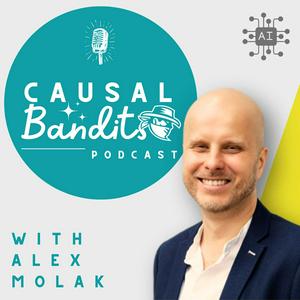
Causal Bandits Podcast with Alex Molak is here to help you learn about causality, causal AI and causal machine learning through the genius of others. The podcast focuses on causality from a number of different perspectives, finding common grounds between academia and industry, philosophy, theory and practice, and between different schools of thought, and traditions. Your host, Alex Molak is an a machine learning engineer, best-selling author, and an educator who decided to travel the world to record conversations with the most interesting minds in causality to share them with you.Enjoy and stay causal!Keywords: Causal AI, Causal Machine Learning, Causality, Causal Inference, Causal Discovery, Machine Learning, AI, Artificial Intelligence
Podcast-WebsiteHöre Causal Bandits Podcast, Darknet Diaries Deutsch und viele andere Podcasts aus aller Welt mit der radio.de-App
Hol dir die kostenlose radio.de App
- Sender und Podcasts favorisieren
- Streamen via Wifi oder Bluetooth
- Unterstützt Carplay & Android Auto
- viele weitere App Funktionen
Hol dir die kostenlose radio.de App
- Sender und Podcasts favorisieren
- Streamen via Wifi oder Bluetooth
- Unterstützt Carplay & Android Auto
- viele weitere App Funktionen

Causal Bandits Podcast
Code scannen,
App laden,
loshören.
App laden,
loshören.
 Deutschland