

Höre diesen Podcast kostenlos in der App: Kostenlos im App Store laden
radio.de
Sleeptimer
Sender speichern
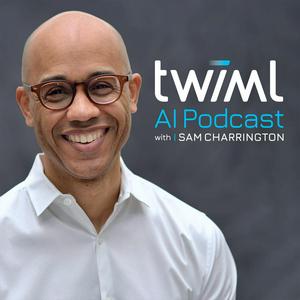
The TWIML AI Podcast (formerly This Week in Machine Learning & Artificial Intelligence)
Sam Charrington
Neueste Episode
799 Episoden
Your Ranking Model Is Optimizing the Wrong Thing with Zoe Weil - #780
15.10.2026 | 52 Min.In this episode, Zoe Weil, co-founder and CEO of Sequen, joins us to discuss how ranking systems can use live behavioral signals to optimize for purchases rather than clicks or search relevance alone. Zoe explains why approaches developed at data-rich social platforms don’t necessarily translate to retailers and how Sequen uses scroll speed, hover duration, and other in-session interactions to infer shopper intent without relying on user identity.
We explore the company’s large event models and its architecture of specialized models that transform streaming events into features for downstream rankers. Zoe describes the infrastructure required to serve dynamic rankings within milliseconds, why the team chose Rust for its backend, and how evaluation harnesses connect model improvements to business outcomes. We also discuss the tradeoffs between advertising and organic revenue, continuous model improvement, and the boundary between useful personalization and surveillance.
🗒️ Full show notes: https://twimlai.com/go/780.Why Jev Is Changing How We Build With AI with Diogo Almeida - #779
06.10.2026 | 1 Std. 30 Min.In this episode, Diogo Almeida, co-founder and CEO of TypeSafe, joins us to discuss Jev, TypeSafe’s recently released model for bringing fast, reliable intelligence directly into software. We explore the idea of “machine-native intelligence” and why Diogo believes models optimized for generating text are poorly suited to many of the decisions required for real-world automation. He explains how Jev differs from traditional classifiers and LLM-based approaches, the role of reinforcement learning from calibrated decisions (RLCD), and why calibration and reliability are central to making AI useful as a software primitive. We also discuss the relationship between models and code, why Diogo believes AI systems should become more engineered rather than relying on a single model to do everything, and how Jev-like models could reshape agents, tool use, and the architecture of AI-powered software.
🗒️ Full show notes: https://twimlai.com/go/779.From Math Olympiads to Navier-Stokes: How Fast Is AI Progressing? with Greg Burnham - #778
29.09.2026 | 1 Std. 7 Min.AI systems have gone from struggling with grade-school math to helping solve research problems that have resisted mathematicians for decades, including Navier-Stokes.
In this episode, Greg Burnham, who leads AI capabilities research at Epoch AI, joins us to examine what that progress says about where AI is going. We look at how these systems are solving hard math problems, how much they rely on persistence and prior human work, and whether they are starting to produce genuinely new ideas.
We also discuss how to measure progress as traditional benchmarks become less useful, why capability gains appear surprisingly steady across model generations, and where models still struggle with open-ended work, learning from experience, and identifying promising new research directions.
🗒️ Full show notes: https://twimlai.com/go/778.From Voice Agents to AI Avatars with Alexander Smola - #777
17.09.2026 | 1 Std. 4 Min.Voice AI has gotten remarkably good, but natural conversation remains a high bar. Small delays, awkward interruptions, or the wrong tone can quickly break the illusion—and adding vision and visual presence only raises the stakes.
In this episode, Alex Smola, co-founder and CEO of Boson AI, explores the path from today’s voice agents to audiovisual agents and AI avatars. We discuss the technical tradeoffs behind real-time voice, including audio tokenization, latency, model size, and inference cost, as well as what changes when these systems can both see and be seen.
We also explore the role of emotional intelligence in AI, how agents can learn from human interactions, and what it will take to move beyond impressive demos toward interactions that actually feel natural.
🗒️ Full show notes: https://twimlai.com/go/777.Do AI Tokenomics Matter More Than Model Benchmarks? with Chris Potts - #776
09.09.2026 | 59 Min.As reasoning models consume more tokens and AI systems become more expensive to run, understanding what those tokens actually buy is becoming increasingly important. In this episode, Stanford professor and Big Spin co-founder Chris Potts joins us to discuss AI tokenomics and his research into “tokenflation”—the possibility that token usage is growing faster than the measurable value those tokens produce.
We explore how to measure the return on AI spending, why benchmarks alone provide an incomplete picture of model progress, and what inference-time scaling means for the economics of increasingly capable models. Chris also explains why expert AI users tend to get better results by challenging and iterating with models, how AI fluency affects outcomes, and why more efficient architectures could change the underlying economics. We also discuss DSPy, interpretability, the limits of today’s transformer architectures, and where Chris sees opportunities for more fundamental innovation in AI.
🗒️ Full show notes: https://twimlai.com/go/776.
Weitere Nachrichten Podcasts









Trending Nachrichten Podcasts






















Über The TWIML AI Podcast (formerly This Week in Machine Learning & Artificial Intelligence)
Machine learning and artificial intelligence are dramatically changing the way businesses operate and people live. The TWIML AI Podcast brings the top minds and ideas from the world of ML and AI to a broad and influential community of ML/AI researchers, data scientists, engineers and tech-savvy business and IT leaders. Hosted by Sam Charrington, a sought after industry analyst, speaker, commentator and thought leader. Technologies covered include machine learning, artificial intelligence, deep learning, natural language processing, neural networks, analytics, computer science, data science and more.
Podcast-WebsiteHöre The TWIML AI Podcast (formerly This Week in Machine Learning & Artificial Intelligence), Machtwechsel und viele andere Podcasts aus aller Welt mit der radio.de-App
Hol dir die kostenlose radio.de App
- Sender und Podcasts favorisieren
- Streamen via Wifi oder Bluetooth
- Unterstützt Carplay & Android Auto
- viele weitere App Funktionen
Hol dir die kostenlose radio.de App
- Sender und Podcasts favorisieren
- Streamen via Wifi oder Bluetooth
- Unterstützt Carplay & Android Auto
- viele weitere App Funktionen
The TWIML AI Podcast (formerly This Week in Machine Learning & Artificial Intelligence)
Code scannen,
App laden,
loshören.
App laden,
loshören.
 Deutschland