PodcastsBildungIsrael/Palestine Podcast

Israel/Palestine Podcast

by Berlin Students
Israel/Palestine Podcast
Neueste Episode

51 Episoden

  • Israel/Palestine Podcast

    Ep. 51: Epilogue: Choosing Justice and Peace (Sima & Mai – Young Ambassadors for Peace / Parents Circle – Families Forum)

    29.12.2025 | 1 Std. 3 Min.

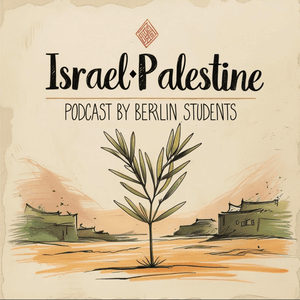
    Guests: Sima & Mai, Young Ambassadors for Peace / Parents Circle –Families Forum Hosts: Alexandria, Mert & Efe Sima and Mai are Young Ambassadors for Peace with the Parents Circle – Families Forum (PCFF), an organization of over 800 bereaved Israeli and Palestinian families who have each lost a close relative to the conflict. Mai lost his grandfather, Haim Perry, an artist and peace activist from Kibbutz Nir Oz, abducted and killed during the attacks of October 7, as well as his uncle Daniel Darlington, who was killed at the Nova Festival. Sima's 14-year-old brother was killed by an Israeli soldier, a loss that profoundly affected her family. Despite these tragedies, both dedicate themselves to reconciliation and dialogue, promoting peace, understanding, and coexistence. Through the Young Ambassadors program, they share this message in schools and communities across Israel, Palestine, and beyond. In this final episode: We listen with the heart. The first and last words of this podcast belong to the people who have lost a loved one but still remain comitted to justice and peace. We begin and end the series with the human reality of the conflict, remembering that real people grieve and endure on both sides. Their stories, losses, and resilience have inspired this journey. The young olive tree on our podcast cover, growing in the desert, reminds us of the hope Sima and Mai bring to Israel and Palestine—the wounded and “magical land between the river and the sea” (Mai) they call home. This episode was recorded July 23, 2025. We dedicate our Podcast series to Sima & Mai, Udi Goren, Khalil Sayegh. To Tal’s wife Ela and their children Niv, Einav, Udi, and Lotan; to Khalil Sayegh’s mother and siblings; to Mai’s and Sima’s families; to her mother Bushra. We dedicate this podcast to the blessed memory of: Tal Chaimi, Lara Sayegh, Jeries Sayegh, Mahmoud, Haim Perry, Daniel Darlington. Efe, Mert, and Alexandria speak with Mai and Sima about their personal losses, the journey of healing, and their work fostering dialogue, understanding, and hope across deep divides. Disclaimer: Guest opinions are their own and do not necessarily reflect the views of the podcast team. Technical legal terms are explained in Episode 36 with Prof. Claus Kreß; contested histories are addressed by Prof. Gudrun Krämer in Episode 21.
  • Israel/Palestine Podcast

    Ep. 50: Challenges for Education: Side by Side – Parallel Histories of Israel/Palestine (Prof. Dr. Eyal Naveh – Tel Aviv University)

    29.12.2025 | 1 Std.

    Guest: Prof. Eyal Naveh – Tel Aviv University Hosts: Yusuf & Mert Bio: Eyal Naveh is an Israeli historian and educator specializing in history education in conflict contexts. He has taught at Kibbutzim College of Education and Tel Aviv University, where he served as Head of the Department of General History and Chair of the General and Interdisciplinary Studies Program. Naveh is co-director of the Peace Research Institute in the Middle East and has been a visiting professor at Harvard, UC Berkeley, Cornell, the University of Toronto, Venice International University, and the University of Vienna. He is best known as a co-creator of the groundbreaking history textbook Side by Side: Parallel Histories of Israel-Palestine (2012), developed with Israeli traumatologist Prof. Dan Bar-On and Palestinian sociologist Prof. Sami Adwan. The book presents Israeli and Palestinian perspectives side by side, enabling students to engage with complex, conflicting narratives without flattening differences. It has received international recognition as a model for post-conflict history education. In this episode: Yusuf and Mert speak with Prof. Naveh about the creation, use, and relevance of the groundbreaking history textbook Side by Side. They discuss collaborating with Israeli and Palestinian educators, the challenges of presenting contrasting narratives, and the book’s reception in schools and academia locally and internationally. The conversation explores the role of history education in conflict regions, political polarization, and teaching empathy, critical thinking, and complex truths to new generations. Prof. Naveh reflects on divisions since October 7, the shrinking space for peace education, and lessons for educators and students in Germany. This episode was recorded July 22, 2025. LInks: Prof. Dr. Eyal Naveh: https://english.tau.ac.il/profile/enaveh Prof. Dr. Sami Adwan: https://www.torgnysegerstedt.se/en/main-article-sami-adwan/ Prof. Dr. Dan Bar On: https://en.wikipedia.org/wiki/Dan_Bar-On https://www.juedische-allgemeine.de/allgemein/pionier-des-dialogs/ Adwan, Sami, Dan Bar-On, and Eyal Naveh, editors. Side by Side: Parallel Histories of Israel-Palestine. The New Press, 2012. https://thenewpress.org/books/side-by-side/?v=eb65bcceaa5f Peace Research Foundation in the Middle East: https://www.vispo.com/PRIME/index.htm Disclaimer: Guest opinions are their own and do not necessarily reflect the views of the podcast team. Technical legal terms are explained in Episode 36 with Prof. Claus Kreß; contested histories are addressed by Prof. Gudrun Krämer in Episode 21.
  • Israel/Palestine Podcast

    Ep. 49: Challenges for Education: Solutions – Not Sides: Experiences in Education from the UK (Sharon Booth & Mohamed Ali Amla – Solutions – Not Sides, UK)

    29.12.2025 | 1 Std. 22 Min.

    Guests: Sharon Booth, CEO Solutions – Not Sides, Mohamed Ali Amla, Public Affairs Director, Solutions – Not Sides Hosts: Mert, Alexandria, Yusuf Bio: Sharon Booth is the Founding Executive Director of Solutions – Not Sides, a leading UK NGO fostering constructive dialogue about Israel/Palestine in schools. She studied Theology and Religious Studies at Cambridge University, taught English in Tunisia, worked on youth publishing initiatives in Amman, and served at the British Embassy. She holds a master’s with distinction from King’s College London, specializing in nationalism and religion. In 2010, she founded Solutions – Not Sides to empower students to engage in non-partisan, solutions-focused learning. Mohammed Ali Amla is the Public Affairs Director at Solutions – Not Sides, overseeing public affairs, crisis communication, strategic partnerships, and youth leadership programs. With over twenty years of experience in faith and policy, he is a researcher, educator, and practitioner. He founded Lita’arafu and Christian Muslim Encounters, advising widely on interfaith dialogue, conflict resolution, peace-building, and community leadership. He focuses on equipping young people to become bridge-builders while addressing antisemitism, Islamophobia, and structural inequality. In this episode: Mert, Alexandria, and Yusuf speak with Sharon Booth and Mohammed Ali Amla about Solutions – Not Sides’ mission and work. They discuss the NGO’s non-partisan, values-driven, and solutions-focused approach, including youth-led workshops and programs such as the Bridge Builders Programme and the Olive Branch Award. The conversation examines strategies for addressing bias, antisemitism, anti-Muslim racism, and for teaching empathy and critical thinking in schools. The guests share insights from classrooms and campuses across the UK, reflecting on broader international implications. Listeners gain practical guidance for creating safe spaces, fostering solutions-oriented thinking, and empowering young people to engage critically and empathetically with one of the world’s most contested conflicts. This episode was recorded September 1, 2025. Links: https://solutionsnotsides.co.uk/ Disclaimer: Guest opinions are their own and do not necessarily reflect the views of the podcast team. Technical legal terms are explained in Episode 36 with Prof. Claus Kreß; contested histories are addressed by Prof. Gudrun Krämer in Episode 21.
  • Israel/Palestine Podcast

    Ep. 48: Challenges for Education: Unsettling Empathy - How to Hold Conflicting Truths at the Same Time? (Prof. Dr. Björn Krondorfer – Northern Arizona University, USA)

    29.12.2025 | 46 Min.

    Guest: Prof. Dr. Björn Krondorfer, Northern Arizona University Hosts: Yusuf & Efe Bio: Björn Krondorfer is the Endowed Professor of Religious Studies and Director of the Martin-Springer Institute at Northern Arizona University. He holds a Ph.D. in Comparative Religion from Temple University and studied Protestant Theology in Frankfurt/Main and Göttingen, Germany. Krondorfer is internationally recognized for his work on post-Holocaust reconciliation, historical trauma, and dialogue among Germans, Israelis, and Palestinians. He brings descendants of Holocaust victims and perpetrators into conversation and extends these dialogues to include Palestinian narratives. He is the author of Unsettling Empathy: Working with Groups in Conflict (2020), Reconciliation in Global Context (2018), and The Holocaust and Masculinities (2020), and facilitates workshops, field encounters, and critical pedagogy that put dialogue into practice. He is the co-chair of the Consortium of Higher Education Centers for Holocaust, Genocide and Human Rights Studies (2020-to date) and the President of the Association for Public Religion and Intellectual Life (2023-to date). In this episode: Yusuf and Efe speak with Prof. Krondorfer about engaging groups affected by historical trauma and conflict, including descendants of Holocaust victims and perpetrators, as well as Germans, Israelis, and Palestinians. They explore intergenerational, transgenerational, historical, and cultural trauma, and how these traumas shape relationships across generations. Krondorfer explains his method of “Unsettling Empathy,” which engages conflicting truths and power dynamics while fostering ethically grounded, emotionally aware dialogue. The discussion covers silenced Palestinian narratives in Germany, Germany’s responsibility toward Israel, and the triangular relationship including Palestinian experiences. Listeners gain insight into how historical wounds, empathy, and self-awareness can transform dialogue, the importance of holding conflicting truths simultaneously, and practical lessons for educators, mediators, and those seeking to bridge deep divides. This episode was recorded July 31, 2025. Links: Prof. Dr. Björn Krondorfer: https://in.nau.edu/martin-springer/staff/about-the-director/ Unsettling Empathy. Working with Groups in Conflict (Bloomsbury, 2020): https://tinyurl.com/mnwdjyhd https://lernen-aus-der-geschichte.de/International/content/12232 Review by Dani Kranz: https://tinyurl.com/mrxtkmpw Disclaimer: Guest opinions are their own and do not necessarily reflect the views of the podcast team. Technical legal terms are explained in Episode 36 with Prof. Claus Kreß; contested histories are addressed by Prof. Gudrun Krämer in Episode 21.

  • Israel/Palestine Podcast

    Ep. 47: Challenges for Education: Evaluating Education on the Israel/Palestine Conflict (Dr. Per Leo – Wissenschaftskolleg zu Berlin)

    29.12.2025 | 1 Std. 14 Min.

    Guest: Dr. Per Leo, Historian & Author, Wissenschaftskolleg zu Berlin Hosts: Efe & Philip Bio: Per Leo studied history, philosophy, and Slavic Studies in Freiburg and Berlin, earning his PhD in 2009 at Humboldt University. His novel Flut und Boden (2015), which reflects on his grandfather Friedrich Leo, an SS-Sturmbannführer, and the family’s history during the Nazi era, was shortlisted for the 2014 Leipzig Book Fair Prize and received several awards. Since 2021, Leo has critically examined German culture of remembrance in the context of the Middle East conflict and migration, notably in his essay Tränen ohne Trauer (2021). He writes for leading publications including Frankfurter Allgemeine Zeitung, Süddeutsche Zeitung, Die Zeit, Die Welt, and Neue Rundschau, and lives in Berlin with his family as a freelance author. He is a 2024/2025 fellow at the Institute for Advanced Study in Berlin (Wissenschaftskolleg zu Berlin) where he examines how schools deal with the Israel/Palestine conflict. In this episode: Efe and Philip speak with Dr. Per Leo about how the Israel-Palestine conflict is addressed in Berlin schools. Drawing on his research and conversations with teachers, parents, and students, Dr. Leo examines how the conflict is taught, how schools both reflect and diverge from broader societal discourse, and the challenges educators face in navigating such a sensitive topic. He reflects on the distinction between memory culture and critical historical consciousness, the importance of the Beutelsbach Consensus in teaching such a contested topic, and the necessity of embracing multiple perspectives. This episode was recorded July 11, 2025. Links: Dr. Per Leo: https://www.wiko-berlin.de/fellows/akademisches-jahr/2024/leo-per Disclaimer: Guest opinions are their own and do not necessarily reflect the views of the podcast team. Technical legal terms are explained in Episode 36 with Prof. Claus Kreß; contested histories are addressed by Prof. Gudrun Krämer in Episode 21.
Weitere Bildung Podcasts

Über Israel/Palestine Podcast

Welcome to our Israel/Palestine Podcast, a project by graduating high school students from Berlin-Neukölln. Our district is home to Germany’s largest Palestinian diaspora and a popular home for many young Israelis abroad. Israel and Palestine are painfully present in our district and in our schools. We've spoken to historians, legal scholars, trauma researchers, and educators — many of them world-leading experts — to better understand a conflict that shapes identities, divides communities, and echoes through generations. Our approach has been multiperspectival. We don’t aim to resolve contradictions or controversies, but to hear different perspectives. Human rights and international law are the foundation of responsible multiperspectivism. Across eight chapters and 51 episodes, we explore human realities, the urgency, history, the legacies of antisemitism and racism, political and legal debates, psychological dimensions, and challenges for education. Featuring: Michel Friedman – one of Germany’s most prominent public intellectuals Alena Jabarine – Germany’s best known Palestinian journalist Gudrun Krämer (FU Berlin) – one of the world’s leading historians of the Middle East Michael Brenner (LMU Munich) & Derek Penslar (Harvard University) – two of the world’s foremost scholars of Zionism Adel Manna (Van Leer Jerusalem Institute) – leading scholar of the Nakba Victor Kattan (University of Nottingham) – leading expert on the legal history of the British Mandate Meron Mendel (Bildungsstätte Anne Frank) – leading educational voice on Israel in Germany Eyal Benvenisti (Yale Law School) – a world leading authority on the laws of occupation Omer Bartov (Brown University) – one of the world’s leading scholars of Holocaust and genocide studies Omri Boehm (The New School) – one of the most influential voices on Israel/Palestine in Germany Shai Hoffmann & Jouanna Hassoun – award winning dialogue leaders Claus Kreß – leading scholar of international criminal law; co-author of the Rome Statute; Special Adviser to the ICC; Judge ad hoc at the ICJ Moshe Zimmermann (Hebrew University of Jerusalem) – one of the foremost scholars of modern Jewish history Yael Danieli – a pioneer of trauma studies, who helped establish all victims’ rights in international law Ken Stern – lead drafter of the IHRA working definition of antisemitism Alex de Waal – world leading authority on hunger and mass violence Norman Stillman – a field-defining authority on Jews in the Islamic World …and many more. Our series begins and ends with voices whose lives were deeply affected by the violence of this conflict: Udi Goren (Bring Them Home Now!), Khalil Sayegh (The Agora Initiative), and Sima & Mai (Young Ambassadors for Peace). “The students did an amazing job assembling this series and organizing the individual episodes.”  — Prof. Derek Penslar, Harvard University “I am not aware of any comparable initiative driven primarily by high school students. Multiperspectivity is a widespread buzzword that is rarely lived up to. This podcast is quite different. The expert voices gathered here all deserve to be heard — they will greatly enrich (not only) the German debate.” — Prof. Simon W. Fuchs, Hebrew University of Jerusalem “A fantastic project.”  — Nazih Musharbash, President, German-Palestinian Society “They should be applauded for their maturity and inner resoluteness in confronting some of the most painful legacies of our time.” — Dr. Yael Danieli, UN Senior Representative "This initiative is both extraordinary and exemplary." — Prof. Claus Kreß, co-author of the Rome Statute; Special Advisor to the ICC; Judge at the ICJ “This series of podcasts, featuring truly internationally leading scholars in their fields, is, I believe, one-of-a- kind." — Prof. Gudrun Krämer, recipient of the 2025 Historikerpreis Impressum: https://israelpalestinepodcast.taplink.site/ Music: Be My Guest – David Fesliyan (Royaltee Free)

Podcast-Website

Höre Israel/Palestine Podcast, Easy German: Learn German with native speakers | Deutsch lernen mit Muttersprachlern und viele andere Podcasts aus aller Welt mit der radio.de-App

Hol dir die kostenlose radio.de App

  • Sender und Podcasts favorisieren
  • Streamen via Wifi oder Bluetooth
  • Unterstützt Carplay & Android Auto
  • viele weitere App Funktionen
Rechtliches
Social
v8.2.1 | © 2007-2026 radio.de GmbH
Generated: 1/1/2026 - 4:21:37 AM