

Höre diesen Podcast kostenlos in der App: Kostenlos im App Store laden
radio.de
Sleeptimer
Sender speichern
43 Episoden
Energy From Orbit: Can We Trust Power Beamed From Space? - Martin Soltau, Space Solar (EP 42)
24.09.2026 | 31 Min.🎙️ with Martin Soltau, Co-CEO, Space Solar
Solar power collected in space and beamed down to Earth sounds like science fiction (it did to the space sector too, until reusable rockets arrived). Martin Soltau, Co-CEO of Space Solar, is building it in the UK, and he is confident about the technology: NASA demonstrated power beaming in the 1970s. The part of his timeline he can't engineer is trust: how quickly regulators and the public accept energy that comes down from orbit.
🎧 Episode overview
It starts with Martin's verdict on Europe's energy transition: the UK and Germany, he says, have "tested it to destruction", and households pay for it with expensive electricity and weaker security. His case for orbit is concrete: a panel in space produces eight to 13 times what it would in the sunniest place on Earth, robots assemble the satellites from coffee-table-sized modules, and the beam can be directed wherever power is needed. Eva pushes on the catch: if launch still runs through a handful of mostly American providers, does Europe swap one dependency for another? On trust, Martin points to fracking (a technology that worked and still lost the public) as his warning, and explains why he answers the safety question with wifi frequencies and intensities anyone can measure.
💡 Key themes
Why a grid built on free sunshine and free wind still delivers expensive electricity
Whether public trust can be earned before the first satellite flies, or only afterwards
What wireless power changes about energy security when undersea cables are already being targeted
Whether governments that fund this will accept standards letting a rival's satellite use their receiver
👤 About the guest
Martin Soltau co-founded Space Solar in 2022 to build solar power satellites that deliver continuous electricity to receivers on the ground. He came from inside the space sector, where the idea sat on the science fiction pile until SpaceX made reusable launch commercial. Today his work is as much about convincing governments and regulators as about engineering.
⏱ Chapters
Tested to destruction (starts with: "I think it's the big challenging problem for humanity ...")
Why orbit beats the sunniest place on Earth (starts with: "So I suppose it starts with the fact that if you put a solar panel into space ...")
Launch, and who controls it (starts with: "Yeah, that's a very good question. I mean, if we look at wind and solar and batteries ...")
Standards between rivals (starts with: "Yes, I think there are many examples of where nations have collaborated ...")
Coffee-table modules and crawling robots (starts with: "Yes. Well, if you came to space solar at Harwell ...")
The trust question (starts with: "I think you use a really interesting word there, trust ...")
🔗 Links
Martin Soltau on LinkedIn - https://www.linkedin.com/in/martin-soltau-44596619/
Eva Simone Lihotzky on LinkedIn - https://www.linkedin.com/in/evalihotzky/
Space Solar - https://www.spacesolar.co.uk
International Telecommunication Union - https://www.itu.int
Related episode - Sten Saluveer on what decides AI trust in Europe - https://open.spotify.com/episode/0gPKehnoNppMY0y3Jvdry0Entering the Era of AI Power: An Estonian View on Europe's Way - Sten Saluveer, Telia (EP 41)
17.09.2026 | 36 Min.🎙️ Sten Saluveer, Growth & Innovation, Telia
What decides AI trust in Europe - the size of the model, or whether people recognise themselves in the society using it? Sten Saluveer helped write Estonia's digital state agenda and now builds at Telia, and he argues Europe enters the era of AI power holding more than it thinks: a working example, and the diversity to invent its own category. For leaders deciding where their organisations stand in that game, this is a view from a country that stopped writing roadmaps and started shipping.
🎧 Episode overview
Sten and Eva move from why a builder who ran innovation at Cannes chose an Estonian telco, to what an agent-driven state actually looks like when more than a hundred and twenty agentic services already run and the plan reads like scenes from a citizen's life. They sit with the uncomfortable side: a quarter in which Estonians lost around thirty million euros to cybercrime, and a security goal that paradoxically aims to keep satisfaction exactly where it is. From Cannes, Sten brings the generational fault line - leaders over forty who see adaptation as given, talents under thirty who experience AI as a threat to their work and their environment - and the question of whether Europe can turn its diversity into its own category rather than playing everyone else's game.
💡 Key themes
Whether a state can make itself agent-driven and keep the citizen in control
Why holding cybersecurity satisfaction at today's level counts as ambition
What Europe's own category could be when it stops measuring itself in gigawatts
The generational split on AI that surfaced at Cannes, and what it demands of leaders
Whether a telco can become the trusted digital partner of the AI economy
👤 About the guest
Sten Saluveer is an Estonian innovation strategist who has spent two decades translating between the market, the technology, and the governance layer - from heading Cannes Next at the Marché du Film to advising the Tallinn Digital Summit. He contributed to Estonia's digital state agenda, where he insisted the plan contain scenarios from ordinary life, and he recently joined Telia heading their growth and innovation initiatives. What makes his perspective matter here is the vantage point: he argues Europe's case from inside a small country where the agent-driven state is already operational.
⏱️ Chapters
[00:00] Why a builder chooses a telco when the era turns
[11:41] An action plan, not a roadmap - the state that ships
[18:11] Standing still as ambition - the cybercrime paradox
[23:15] When infrastructure has to assume it is a target
[28:03] Cannes: the generation that experiences AI as a threat
[38:26] Reclaiming agency - Europe's own category
🔗 Links
Sten Saluveer on LinkedIn - https://www.linkedin.com/in/stensaluveer/
Eva Simone Lihotzky on LinkedIn - https://www.linkedin.com/in/evalihotzky/
Telia - https://www.telia.ee/era
Estonia's digital state agenda - https://digital-skills-jobs.europa.eu/en/initiatives/national-strategies/estonia-estonian-digital-agenda-2030
Related episode - 'Tech and Democracy with Nexus Politics' https://open.spotify.com/episode/3WVnBsaz3LfFPwn6xsX1N6Captured or AI Created? Tech Ethics of Photography - Noah Wetzel (EP 40)
10.09.2026 | 35 Min.🎙️ Noah Wetzel, Photographer
What happens to AI trust when the most real photographs are the ones people refuse to believe? Noah Wetzel spent nine months and 600 hours preparing to capture 84 seconds of a total solar eclipse - then had to prove the result came out of a camera. This one is for anyone whose genuine work now meets default suspicion, and anyone deciding where AI belongs in a craft that has to stay real.
🎧 Episode overview
Noah captured a wingsuit athlete flying through totality in Spain: flashes triggered from a mile away, a subject moving at 150 miles per hour, two frames per athlete, no second takes. The conversation follows what came after the shutter - viewers at his own shows assuming the work is fake, magazine editors auditing every edit in his raw files, and a disclaimer on Instagram stating his photos are camera-captured. He is blunt about his own AI use: hundreds of hours on ChatGPT planning the shot, AI saving him days in processing, and a hard line at the frame itself. Where that line sits, and whether it survives cameras that can generate content on demand, stays open until the end.
🔍 Key themes
Why extraordinary authentic images now read as fake by default, and who ends up carrying the burden of proof
Where AI strengthens a craft and where it disqualifies the result - the captured versus created distinction Noah refuses to blur
What "the ethics of photography" means when every edit is contestable and everyone draws the line differently
What happens to that line when the camera itself can add what was never there
How you perform inside 84 seconds when preparation is the only thing left to trust
📸 About the guest
Noah Wetzel is an adventure and action-sports photographer, and the person behind what may be the most complex photograph ever attempted: a Red Bull Air Force wingsuit athlete crossing a total solar eclipse. The detail that matters for this episode is what he does after the work is done - he attaches a statement to his published images confirming they were captured by a camera, because the audience's default assumption has flipped. He argues the case for craftsmanship from inside a working life that uses AI daily.
⏱ Chapters
[00:00] 600 hours for 84 seconds
[04:33] Trusting preparation when nothing can be paused
[16:30] What generative AI changes about believing a photograph
[24:02] Why real work now carries a disclaimer
[31:41] Where the in-camera line starts to dissolve
🔗 Links
Noah Wetzel's website / portfolio — www.wetzelgallery.com
Noah Wetzel on Instagram, www.instagram.com/noahwetzel
Noah Wetzel on Facebook: www.facebook.com/noahwetzelphoto
[LINK: Related episode — suggest a Pillar 1 episode on trust in AI systems, Eva to match to episode number]
Eva Simone Lihotzky on LinkedIn - https://www.linkedin.com/in/evalihotzky/
Documentary Released on PBS Recently - April 8th 2024 Total Solar Eclipse in Hill Country Texas. The film has received 17 film festival awards and been aired 1700+ times in the last month across 39 different states in the United States. You can watch the documentary online here:
https://www.pbs.org/show/eclipse-outlaw-chase/AI and Sustainability: Lessons from Both Transformations - Dr. Kiri Trier (EP 39)
03.09.2026 | 33 Min.🎙️ Dr. Kiri Trier, Chief Marketing & Growth Officer at Risk Management Partners, part of Munich Re
👋🏻 Opening paragraph
Every C-level claimed sustainability expertise overnight. Dr. Kiri Trier watched it happen, and she sees AI trust heading the same way. She spent more than a decade leading sustainability transformation before the current wave, and now runs growth inside Munich Re's climate risk business while the second hype cycle unfolds around her. This one is for leaders who suspect the pace of AI adoption has outrun the understanding beneath it.
🧭 Episode overview
In this episode, Dr. Kiri Trier maps the sustainability cycle onto the AI one: the expectation management problem when nobody knows the consequences, the human resource comparison that sustainability never triggered, and why she laughed the first time she heard "human in the loop". From inside reinsurance she raises the question with no settled answer yet - when a model judges wrong, what about the liability? And she closes with a definition that reorders most AI governance thinking: trust arrives only as an outcome of credibility and reliability.
💡 Key themes
When a model judges a policy wrong, who carries the liability - and why the autonomy still lies on the human side
Whether the EU AI Act repeats the German supply chain law: does checklist regulation produce compliance or trust?
What greenwashing predicts about AI washing, from someone who watched the first one form
Can trust be installed at all, or only earned as an outcome of credibility and reliability?
The gut feeling as a leadership instrument the LLM does not have
👤 About the guest
Dr. Kiri Trier is Chief Marketing & Growth Officer at Risk Management Partners, a Munich Re company localising climate risk exposure. The detail that matters for this episode: seven years before the current wave, she published on how AI would change sustainability management - which means she entered the AI transformation already knowing how a hype cycle ends.
⏱️ Chapters
[01:31] Trust is a behaviour - so what is trust in a technology?
[04:09] The overnight experts return
[09:32] Human in the loop, turned around
[16:10] The foresight existed - Sustain what?
[26:00] When regulation becomes Excel lists
🔗 Links
Dr. Kiri Trier on LinkedIn - https://www.linkedin.com/in/dr-kiri-trier-97bb1611/
Eva Simone Lihotzky on LinkedIn - https://www.linkedin.com/in/evalihotzky/
Risk Management Partners website - https://www.munichre.com/rmp/en.html
Related episode: 'Designing regenerative futures' with Karel Golta - https://podcasts.apple.com/de/podcast/the-in-between-tech-and-trust-podcast/id1828521905?l=en-GB&i=1000721908996Building Trustworthy Open Source AI - Sebnem Erener (EP 38)
27.08.2026 | 23 Min.🎙️ with Sebnem Erener, AI Governance & Policy Expert
🎧 Opening
Europe is investing billions in open source AI as the trustworthy path, and this episode asks a simple question about that plan: does open actually mean trustworthy? Sebnem Erener works on AI governance, and her answer is no, or at least not on its own. Open source spreads access to a model. Whether you can trust it, and who answers when it goes wrong, are different questions with different answers.
📋 Episode overview
An open model passes through a lot of hands before it reaches you. Sebnem counts five or six: uploaded to a platform, hosted somewhere else, routed, fine-tuned, served. The law usually wants one company to hold responsible, and that's not how the open ecosystem works. She spent years at Klarna as its Head of AI Legal, Regulatory and Ethics, and she now studies where this gap sits. We talk about why she cares more about trustworthiness than trust, what open source can and can't fix on its own, and why she thinks a person can be held liable but a model never can, no matter how independently it acts. It's a conversation for anyone building on an open model, or writing the rules for one, who wants to know who's actually accountable.
🧭 What you'll hear
Why an open model can leave you less sure who's liable than a closed one
The line between real openness and what Sebnem calls "open washing"
Where Europe should be patient, where it should be bold, and why one timeline for all of it is a mistake
Why calling AI "agentic" doesn't move the responsibility onto the machine
The thing Europe is short on, which isn't innovation
👤 About Sebnem Erener
Sebnem Erener works on frontier AI governance and policy across EU, UK, and US frameworks. Before going independent she was Head of AI Legal, Regulatory and Ethics at Klarna, so she has handled these questions inside a company and not only in theory. She's an advocate for open source AI, and she's precise about what it does and doesn't solve. Her forthcoming paper on the governance of open source AI intermediaries runs underneath a lot of this conversation.
⏱️ Chapters
[00:00] What we mean when we say "trust"
[05:00] The five or six hands on every open model
[09:00] When open makes accountability harder
[12:00] One package, four timelines: patience and boldness for Europe
[14:30] Why "agentic" lets no one off the hook
🔗 Links
Sebnem Erener on LinkedIn - https://www.linkedin.com/in/sebnemerener/
Sebnem Erener website - https://www.sebnemerener.com
Eva Simone Lihotzky on LinkedIn - https://www.linkedin.com/in/evalihotzky/
European Commission tech sovereignty package - https://digital-strategy.ec.europa.eu/en/policies/eu-tech-sovereignty
OpenEuroLLM - https://openeurollm.eu
Related episode - beyond the black box with Prof Dr Tina Weisser: https://open.spotify.com/episode/6yKMLQNnDoa6NqqClJrryN?si=3AWXxowURVujJL5m3zD5QQ
Weitere Technologie Podcasts
 Mac & i - der Apple-PodcastTechnologie
 ARD Klima UpdateTechnologie
 c't 4004 – der c't-3003-PodcastTechnologie
 Bits und soNachrichten, Tech-News, Technologie
 byteBildung, Nachrichten, Tech-News, Technologie
 ApfelfunkTechnologie
 Darknet Diaries DeutschTechnologie
- The In-Between Tech and Trust PodcastTechnologie
 kurz informiert by heise onlineNachrichten, Tech-News, Technologie
Trending Technologie Podcasts
 audiodumpDesign, Kunst, Technologie
 TBPNFirmengründung, Technologie, Wirtschaft
 硅谷101Firmengründung, Technologie, Wirtschaft
 Generative Now | AI Builders on Creating the FutureTechnologie
 The TWIML AI Podcast (formerly This Week in Machine Learning & Artificial Intelligence)Nachrichten, Tech-News, Technologie, Wissenschaft
 Vernetzt - Der Telekom PodcastTechnologie
 Stadtbibliothek StuttgartBildung, Bücher, Kunst, Technologie
 The MAD Podcast with Matt TurckTechnologie
 Well There‘s Your ProblemTechnologie
 ClassicPodCars - das Oldtimer MagazinTechnologie
 Der Industrie Podcast des VDMAManagement, Nachrichten, Technologie, Wirtschaft, Wirtschaftsnachrichten
 Sockenpuppenzoo – Angriff auf WikipediaDokumentation, Gesellschaft und Kultur, Technologie
 Elektrogeflüster – E-Mobilität im RealitätscheckFreizeit, Nachrichten, Rund ums Auto, Tech-News, Technologie
 F.A.Z. BornscheinTechnologie
 c't PhasenlageTechnologie
 Maschinenraum - Der Maschinenbau-PodcastTechnologie, Wirtschaft
 KI - kurz und informativ, Klartext "to Go" in unter 5 MinutenBildung, Kurse, Technologie
 DenoisedNachrichten, TV und Film, Tech-News, Technologie
Über The In-Between Tech and Trust Podcast
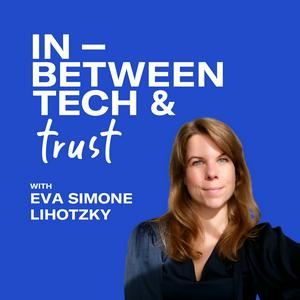
The podcast explores how we build, break, and rebuild trust in a world shaped by accelerating technology and artificial intelligence. Hosted by Eva Simone Lihotzky, AI adoption and ethics expert with 12+ years of experience in tech, the podcast creates in-depth conversations at the intersection of AI, business, ethics, and human connection. Through various lenses - across business, politics, neuroscience, tech and systems thinking in organizations - it hosts expert conversations for you to deep dives into one of the complex topics we need to solve as a society and beyond.
Podcast-WebsiteHöre The In-Between Tech and Trust Podcast, Mac & i - der Apple-Podcast und viele andere Podcasts aus aller Welt mit der radio.de-App
Hol dir die kostenlose radio.de App
- Sender und Podcasts favorisieren
- Streamen via Wifi oder Bluetooth
- Unterstützt Carplay & Android Auto
- viele weitere App Funktionen
Hol dir die kostenlose radio.de App
- Sender und Podcasts favorisieren
- Streamen via Wifi oder Bluetooth
- Unterstützt Carplay & Android Auto
- viele weitere App Funktionen

The In-Between Tech and Trust Podcast
Code scannen,
App laden,
loshören.
App laden,
loshören.
 Deutschland