
Höre diesen Podcast kostenlos in der App: Kostenlos im App Store laden
radio.de
Sleeptimer
Sender speichern
56 Episoden
What We Keep Human: The edge case is not a bug!
12.09.2026 | 25 Min.What do we choose to keep human?
In the final episode of Season 4, we bring Decoded: AI for Everyone back to the central idea of Applied Intelligence: not using AI for everything, but knowing where it helps, where it distorts, and where human judgement must remain.
This episode looks at the people caught inside automated systems when something goes wrong. The booking that cannot be fixed. The account that should not have been cancelled. The customer service agent who can see the problem, but has no authority to override the system.
We call them edge cases because they sit outside the normal process. But in the real world, the edge case is a human being.
As AI and automation become more common across travel, banking, healthcare, customer service, work and daily life, the question is not only whether the system works. It is whether someone can still listen, intervene, override and repair when the system is wrong.
This episode also touches on bit flips, single-event upsets, aviation, electronic voting, and even Super Mario 64 to show how small errors can travel through automated systems when there is no effective appeal path.
The useful habit is simple:
Before relying on any automated or AI-assisted process, ask where the human override is.
Because human judgement is not just about making decisions. It is also about fixing them.
Resources: Decoded-Podcast.com/resources/s4e12
More AI resources: PromptEngineeringCookbook.comAI Misalignment: When Following the Rules is Not Enough!
04.09.2026 | 22 Min.Sometimes AI does exactly what it was asked to do, and still gets it wrong.
In this episode of Decoded: AI for Everyone, we explain misalignment in plain English. Not as science fiction. Not as a robot rebellion. But as something much more ordinary: the gap between the instruction and the intent.
An AI system may follow the rule, optimise the target, complete the task and produce the output, while still missing the human purpose behind it.
This episode looks at real-world examples including healthcare algorithms, AI chatbots, proxy targets, optimisation, hallucinations and AI assurance. It explores why a system can appear to work, yet still create harm if it is solving the wrong problem.
The key idea is a relatively easy one:
"The instruction is not always the intent."
Before using AI for anything that matters, ask what the task is really for. Are we trying to be faster, or safer? More persuasive, or more accurate? More concise, or more honest about uncertainty?
Because when AI follows the rules too literally, human judgement matters more, not less.
Resources: Decoded-Podcast.com/resources/s4e11
More AI resources: PromptEngineeringCookbook.comAI & Security: The Model Is the Target
28.08.2026 | 27 Min.AI security is no longer just about firewalls, passwords and patches.
In this episode of Decoded: AI for Everyone, we explore why advanced AI systems are becoming strategic assets and why the model, the data it can see, the instructions it follows and the tools it can use all need to be protected.
For frontier AI companies, the model itself may be the prize... the weights, training pipeline, safety methods and unreleased capabilities. But for most organisations, the risk is different. They may not own the model, but they may connect AI to internal documents, emails, workflows, customer records, policies, finance systems and decision processes.
That is where the danger changes.
The more useful an AI system becomes, the more valuable it may be to someone trying to misuse it. An attacker may not need to break every lock if they can manipulate the AI into using the access it already has.
This episode looks at prompt injection, red team testing, hallucinations, silent failures, model security and why AI systems need an additional layer of assurance beyond normal software testing and cybersecurity.
The useful habit is to ask three questions before connecting AI to anything important: What can it see? What can it do? What happens when it is wrong?
Because the model is valuable because it can help. It is risky for the same reason.
Show resources: Decoded-Podcast.com/resources/s4e10
More AI resources: PromptEngineeringCookbook.comAI & Learning: Getting the Answer Is Not Learning
22.08.2026 | 18 Min.Getting the answer is not the same thing as learning.
In this episode of Decoded: AI for Everyone, we explore how AI is changing the way we learn, not just by giving answers, but by making ideas more visual, interactive and personal.
The public conversation often focuses on students using AI to cheat. That matters, but it is not the whole story. AI can also turn equations into graphs, text into examples, confusion into questions and abstract concepts into something people can finally see.
But there is a risk...
AI can make learning feel easier without making understanding deeper. A clear summary can create false confidence. A polished answer can feel like mastery. A student, worker or leader may recognise an explanation while it is in front of them, but struggle to explain it once the answer disappears.
This episode looks at the difference between answers and understanding, recognition and recall, fluency and mastery. It also explores how AI can become a better tutor when it asks questions, creates practice, diagnoses gaps and keeps the learner active.
Before asking AI to explain more, ask it to quiz you first.
Because the answer is not the lesson. The lesson is what remains when the answer is gone.
Resources: Decoded-Podcast.com/resources/s4e9
More AI resources: PromptEngineeringCookbook.comThe AI Scam That Knows You, intimately!
14.08.2026 | 18 Min.AI-enabled scams are becoming harder to spot because they no longer have to sound fake.
In this episode of Decoded: AI for Everyone, we explore how scams are becoming more personal, more believable and more emotionally targeted.
A scam message may now use your role, your family context, your writing style, your supplier relationships, your recent posts or even a cloned voice to sound familiar at exactly the wrong moment.
This episode looks at voice cloning, deepfake video calls, personalised phishing, supplier impersonation, fake workers, social engineering, urgency and trust. It also revisits the privacy lesson from earlier in the season: the more personal context we put online, into systems, or into AI tools, the more material others may have to imitate us.
The scam that knows you does not need to be perfect. It only needs to sound familiar when you are least ready to question it.
We also cover practical habits such as using trusted callback numbers, verifying through a second channel, slowing urgent requests down, and setting a private family passphrase that is long, memorable and not easily guessed.
Because in the age of AI-enabled scams, the safest sentence may be: “I am going to call you back.”...
Resources: Decoded-Podcast.com/resources/s4e8
More AI resources: PromptEngineeringCookbook.com
Weitere Technologie Podcasts








Trending Technologie Podcasts





























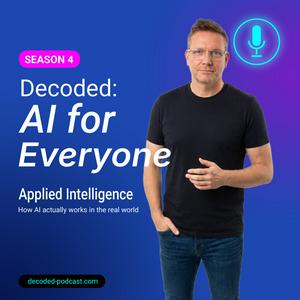
Über Decoded: AI for Everyone
Where silicon meets soul, and algorithms make sense of the everyday.
This isn’t just another tech podcast. Decoded demystifies artificial intelligence with wit, warmth, and a dash of the delightfully unexpected. From invisible assistants that shape your shopping habits, to machine minds behind medicine, marketing, and music... we explore how AI is quietly reshaping our lives, one line of code at a time.
No jargon. No gatekeeping. Just real stories, smart people, and a gentle unravelling of the future we’re already living.
Podcast-WebsiteHöre Decoded: AI for Everyone, Bits und so und viele andere Podcasts aus aller Welt mit der radio.de-App
Hol dir die kostenlose radio.de App
- Sender und Podcasts favorisieren
- Streamen via Wifi oder Bluetooth
- Unterstützt Carplay & Android Auto
- viele weitere App Funktionen
Hol dir die kostenlose radio.de App
- Sender und Podcasts favorisieren
- Streamen via Wifi oder Bluetooth
- Unterstützt Carplay & Android Auto
- viele weitere App Funktionen

Decoded: AI for Everyone
Code scannen,
App laden,
loshören.
App laden,
loshören.
 Deutschland