

Höre diesen Podcast kostenlos in der App: Kostenlos im App Store laden
radio.de
Sleeptimer
Sender speichern
388 Episoden

The Technology for Fully Autonomous Attack Is Already Here | Alex Liannyi, NORDA Dynamics
24.09.2026 | 19 Min.The AI systems guiding Ukrainian combat drones aren't running on expensive Nvidia chips. They're running on a Raspberry Pi Zero - a $15 hobby computer - and that single detail tells you more about how Ukraine's drone war is actually being fought than any headline about AI weapons. Craig Smith sits down with Alex Liannoy, CTO of NORDA Dynamics, for a technically specific and operationally candid conversation about what autonomous drone guidance looks like from inside the team building it. NORDA builds the avionics and targeting modules that plug into drones made by approximately 40 of Ukraine's hundreds of manufacturers, solving the two problems that make drone warfare hard at range: GPS denial from jamming, and the radio horizon that causes pilots to lose contact with their drone in the final 300 to 400 meters before ground level. NORDA's terminal guidance module takes over at up to one kilometer from the target, completing the approach autonomously while a human pilot's earlier lock defines the destination.
The most counterintuitive finding in the episode is about what keeps humans in the loop, and it isn't ethics. Alex's argument is pragmatic: military doctrine requires proof that a drone hit its intended target. If you're monitoring the drone to verify the hit, you have enough connection to control it, which makes full autonomy less necessary than it might appear. That said, he's clear that the technology is "very close", one pilot already controls up to 32 drones simultaneously in some deployed systems, and target detection AI for notifying pilots of candidate targets is already in the field. The episode closes with a hardware finding that should recalibrate anyone's assumptions about AI compute requirements: after engineers mocked NORDA for using Raspberry Pi 4, they moved to the smaller, less powerful Raspberry Pi Zero. Both run real-time computer vision in active combat. The lesson Alex draws is precise: good engineering overcomes chip limitations, bad engineering can overload even a high-end processor.
Subscribe to Eye on A.I. for weekly conversations with the people building and deploying the future of AI.Inside Ukraine's Drone War: Maj. "Phoenix" of Lasar's Group
21.09.2026 | 1 Std. 5 Min.The first armed drone Ukraine ever fielded wasn't built in a factory or procured from a defense contractor. It was built in four months by a network engineer using a Starlink terminal and a large agricultural quadcopter frame, and the man who built it, Maj Phoenix, co-founder of Lasars Group, joins Craig Smith in Kyiv to explain exactly how it happened and what the battlefield looks like now. The conversation traces the full arc from that first prototype - with its two-person crew of pilot and navigator, operating beyond line of sight using satellite imagery and landmarks - to the layered drone architecture Lasars Group now operates: FPV drones on fiber optic covering 30 kilometers, heavy bombers reaching 65 kilometers, ISR planes surveilling the entire range, and interceptors protecting each crew position.
The most unexpected part of this conversation is what drone technology has done to the physical shape of the war. As drone range has expanded - from rifles at 400 meters to FPV at 10 kilometers to heavy bombers at 65 kilometers - the kill zone between the two armies has grown to match, pushing human soldiers further apart and turning the conflict increasingly into drones fighting drones rather than people fighting people. Phoenix frames this explicitly as a reduction in human casualties. The episode also reveals a genuinely surprising institutional innovation: Ukraine's "Army of Drones Bonus" system, a gamified procurement platform where units earn virtual points for destroyed targets and spend them on a drone marketplace, creating competition among manufacturers to build cheaper, more effective systems and directing the best equipment to the highest-performing units. Craig also asks directly about the psychological reality of FPV warfare, following a specific soldier through a camera, watching him try to hide, and killing him, and Phoenix answers with a moral clarity that is both philosophically coherent and quietly unsettling.
Subscribe to Eye on A.I. for weekly conversations with the people building and deploying the future of AI.The Hidden Algorithm That Decides Which Software AI Will Recommend | Tim Sanders, G2
14.09.2026 | 58 Min.Most companies investing in AI visibility are optimizing for the wrong thing. Being cited by an AI response and being recommended by an AI response are completely different outcomes, with click-through rates that differ by a factor of 70. Tim Sanders, Chief Innovation Officer of G2 and executive fellow at Harvard's AI Institute, joins Craig Smith to explain the hidden mechanics behind how ChatGPT and Gemini actually decide which software to recommend, and why the answer has almost nothing to do with what's on your website. When a user asks a commercial intent question, both models enter a "validation layer" process that specifically down-weights vendor content and seeks verified third-party signals: appearance on authoritative lists (41% of the recommendation weight), awards and accreditation (18%), and online reviews (16%). None of these can be manufactured. They must be earned.
The conversation covers the structural transformation in how B2B software buyers behave, half now start their search with an AI prompt, up from 29% a year ago, with two-thirds projected within a year, and why most companies' organic search traffic is on a structural path toward zero. Sanders also delivers some of the most specific competitive data on AI model usage available anywhere: ChatGPT does live retrieval 100% of the time on research queries; Claude does it less than 40% of the time. ChatGPT and Gemini account for 81% of G2's AI research citations. And more than one in four enterprise employees bypass corporate AI tools entirely, using their personal ChatGPT because it has their memory and none of the guardrails.
The episode closes with Sanders' most forward-looking prediction: within three years, AI agents will write the prompts, locate the software, and purchase it on behalf of businesses - with minimal human checkpoints - making the trust infrastructure G2 has built over more than a decade the most valuable asset in the AI-driven buying cycle.
Subscribe to Eye on A.I. for weekly conversations with the people building and deploying the future of AI.The Reason 30 Years of Cybersecurity Has Failed - and What Actually Fixes It | Trent Telford, Qanapi
10.09.2026 | 55 Min.Every major data breach in the last 30 years shares the same root cause: the data inside the wall was never protected, only the wall. And AI frontier models are now making that wall easier to breach than ever, scanning codebases externally to discover undisclosed vulnerabilities and write exploits before anyone knows the hole exists. Trent Telford, Chairman, CEO & Founder of Qanapi, joins Craig Smith to explain why the entire architecture of conventional cybersecurity is structurally broken, and what a genuinely different approach, built from the opposite assumption, looks like. Rather than trying to build a better wall, Qanapi starts from the baseline that the data will eventually be exposed, and encrypts it at the individual word, paragraph, or database cell level, tying each unique key to a verified identity and a set of conditional policies that must all be met simultaneously before anything can be decrypted.
The most commercially urgent application of this architecture is one that unlocks AI adoption for enterprises that have been sitting on the sidelines: Qanapi's gateway service encrypts sensitive fields before data reaches Claude, ChatGPT, or any other frontier model, and the model simply reports it cannot read the encrypted sections, while still reasoning over everything else. Trent discusses how Qanapi's Fathom tool confirmed in testing that Claude could not read the encrypted sections. He describes two major retailers - one using AI heavily, one abstaining entirely because of data security concerns - and asks the question every enterprise leader should be sitting with: how long can you last off the train before you get blitzed? The episode also covers drone security in denied wireless environments, the post-quantum encryption mandate that federal agencies have no practical plan to execute, and why Qanapi's business has exploded in the last six months as the AI gold rush has finally turned its attention from models to infrastructure.
Subscribe to Eye on A.I. for weekly conversations with the people building and deploying the future of AI.86% of What Coding Agents Do Is Just Reading — Not Solving | Alexander Whedon of Subquadratic
08.09.2026 | 54 Min.Every AI model in production today has the same hidden tax: doubling the context window quadruples the compute. That's what quadratic compute complexity means in practice, and it's the reason enterprises are spending most of their AI engineering budget on context management rather than on the actual problems they're trying to solve. Alexander Whedon, co-founder and CTO of Subquadratic, joins Craig Smith to explain how SubQ's sparse attention mechanism eliminates that tax, achieving 40 times faster inference and 64 times less compute than standard attention at one million tokens, and what becomes possible when that constraint disappears. The conversation covers striking benchmark findings: 86% of what frontier coding agents do is "read steps," just trying to gather and organize context before the actual problem-solving begins, and frontier models drop well below 50% accuracy on financial document analysis at 500,000 tokens, revealing how asymmetric long context capability actually is across industries.
The most commercially important argument in this episode is about enterprise data. Most large organizations are sitting on hundreds of billions of tokens of data they've never been able to put to work in an AI product, told they need a $10 million data transformation project before they can even start building. Alex's core claim is that SubQ's architecture makes that barrier no longer necessary, enabling enterprises to process far more of their data with far less curation, at a fraction of the cost. He closes with what he describes as the most important and underexplored frontier in AI right now: we are still very far from understanding what users actually want from models reasoning over millions of tokens, and the product and alignment work needed to answer that question has barely begun.
Subscribe to Eye on A.I. for weekly conversations with the people building and deploying the future of AI.
Weitere Technologie Podcasts
 Tech, KI & SchmetterlingeBildung, Technologie, Wirtschaft
 Mac & i - der Apple-PodcastTechnologie
 ARD Klima UpdateTechnologie
 byteBildung, Nachrichten, Tech-News, Technologie
 Flugforensik - ein Absturz und seine GeschichteTechnologie
 Darknet Diaries DeutschTechnologie
 c't 4004 – der c't-3003-PodcastTechnologie
 The In-Between Tech and Trust PodcastTechnologie
 ApfelfunkTechnologie
Trending Technologie Podcasts
 audiodumpDesign, Kunst, Technologie
 TBPNFirmengründung, Technologie, Wirtschaft
 硅谷101Firmengründung, Technologie, Wirtschaft
 Generative Now | AI Builders on Creating the FutureTechnologie
 The TWIML AI Podcast (formerly This Week in Machine Learning & Artificial Intelligence)Nachrichten, Tech-News, Technologie, Wissenschaft
 Vernetzt - Der Telekom PodcastTechnologie
 Stadtbibliothek StuttgartBildung, Bücher, Kunst, Technologie
 The MAD Podcast with Matt TurckTechnologie
 Well There‘s Your ProblemTechnologie
 ClassicPodCars - das Oldtimer MagazinTechnologie
 Der Industrie Podcast des VDMAManagement, Nachrichten, Technologie, Wirtschaft, Wirtschaftsnachrichten
 Sockenpuppenzoo – Angriff auf WikipediaDokumentation, Gesellschaft und Kultur, Technologie
 Elektrogeflüster – E-Mobilität im RealitätscheckFreizeit, Nachrichten, Rund ums Auto, Tech-News, Technologie
 F.A.Z. BornscheinTechnologie
 c't PhasenlageTechnologie
 Maschinenraum - Der Maschinenbau-PodcastTechnologie, Wirtschaft
 KI - kurz und informativ, Klartext "to Go" in unter 5 MinutenBildung, Kurse, Technologie
 DenoisedNachrichten, TV und Film, Tech-News, Technologie
Über Eye On A.I.
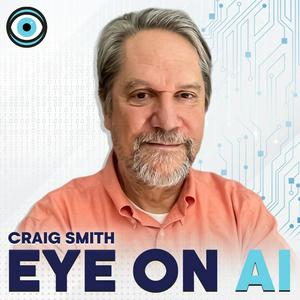
Eye on A.I. is a biweekly podcast, hosted by longtime New York Times correspondent Craig S. Smith. In each episode, Craig will talk to people making a difference in artificial intelligence. The podcast aims to put incremental advances into a broader context and consider the global implications of the developing technology. AI is about to change your world, so pay attention.
Podcast-WebsiteHöre Eye On A.I., Tech, KI & Schmetterlinge und viele andere Podcasts aus aller Welt mit der radio.de-App
Hol dir die kostenlose radio.de App
- Sender und Podcasts favorisieren
- Streamen via Wifi oder Bluetooth
- Unterstützt Carplay & Android Auto
- viele weitere App Funktionen
Hol dir die kostenlose radio.de App
- Sender und Podcasts favorisieren
- Streamen via Wifi oder Bluetooth
- Unterstützt Carplay & Android Auto
- viele weitere App Funktionen

Eye On A.I.
Code scannen,
App laden,
loshören.
App laden,
loshören.
 Deutschland