
Höre diesen Podcast kostenlos in der App: Kostenlos im App Store laden
radio.de
Sleeptimer
Sender speichern
520 Episoden
The Berlin Wall mural and a new kind of zoo
24.10.2026 | 1 Std.Max Pearson presents a collection of this week's Witness History episodes.
American artist Keith Haring's bold 1986 mural on the Berlin Wall and British naturalist Gerald Durrell's 1950s mission to save species from extinction.
We discuss other examples of art which aim to bring peace and unity around the world with Dr Lucy Weir, head of art history at the University of Edinburgh.
Plus Malta's divorce referendum in 2011, Hungary's 1956 uprising, the first Refugee Olympic Team of 2016 and how Ten Canoes made cinema history in Australia in 2006.
Contributors:
Alexandra Hildebrandt - the chairwoman of the Wall Museum at Checkpoint Charlie in Berlin.
Dr Lucy Weir - the head of the history of art at the University of Edinburgh.
Gerald Durrell - British naturalist.
Jeffrey Pullicino Orlando - Maltese MP.
Péter Pallai - survivor of the Hungarian uprising.
Frances Djulibing - actor in Ten Canoes.
Rose Lokonyen - 800m runner for the Refugee Olympic Team.
(Photo: Keith Haring painting his mural on the Berlin Wall in 1986. Credit: Patrick Piel/Gamma-Rapho via Getty Images)The chimpanzee who learned American sign language and monkeys in space
17.10.2026 | 1 Std.Max Pearson presents a collection of the week's Witness History episodes from the BBC World Service.
We hear about the tests on baby rhesus monkeys which would become some of the most controversial in modern science. Also, the chimpanzee who apparently learned American sign language.
Our guest zoologist Megan McCubbin discusses how ethics around using animals in experiments have changed over the years. And we hear about the two monkeys that were sent into space in the late 1950s.
Also the campaign to get chimps listed as endangered, and the murder of the mountain gorilla scientist Dian Fossey. Finally in this week's Sporting Witness, we learn why Manchester City fans started taking inflatable bananas to games in the late 80s.
Contributors:
Harry Harlow - psychologist.
Roger Fouts - worked with Washoe the chimpanzee.
Megan McCubbin - zoologist and author.
Dr Ron Nowak - led the team which declared chimpanzees endangered.
Lieutenant Joe Guion - commander of the USS Kiowa.
Kelly Stewart - Dian Fossey’s colleague.
Dr Gary James - football historian.
Imre Varadi - former Man City striker.
(Photo: Monkeys Able and Baker at a press conference to mark their return from space. Credit: Keystone/Getty Images)The Falklands War and the assassination of Anwar Sadat
10.10.2026 | 1 Std. 2 Min.Max Pearson presents a collection of the week's Witness History episodes from the BBC World Service.
We hear from one of the Peruvian pilots who secretly flew fighter jets to help Argentina during the Falklands War in 1982. We discuss with our guest, Iberian and Latin American historian Stella Krepp from Bern University, about the stance Peru and other countries from the region took in the conflict.
Plus, the killing of the Egyptian president Anwar Sadat in 1981, the mirrors that brought winter sunshine to a Norwegian town, the rats that were trained to detect landmines, and the real-life boy who inspired the Winnie-the-Pooh books.
Finally, this week's Sporting Witness – the day Australia’s cricket captain had to choose between setting a personal record and his team’s chance to win.
Contributors:
Rubén Mimbela – former Peruvian Air Force pilot.
Jehan Sedat – Anwar Sadat’s widow.
Martin Andersen – inventor and artist.
Bart Weetjens – product designer.
Christopher Robin Milne – son of author A.A. Milne (archive).
Mark Taylor – Australia’s former cricket captain.
(Photo: Argentina's Air Force patrol during the Falklands War. Credit: Fireshot/Universal Images Group via Getty Images)Sulawesi's historic cave art and the discovery of the Dead Sea Scrolls
03.10.2026 | 1 Std.Max Pearson presents a collection of this week's Witness History interviews from the BBC World Service.
Our guest is Dr. April Nowell, a paleolithic archaeologist and professor of anthropology at the University of Victoria in Canada.
We start by hearing how in 2012, archaeologists on the Indonesian island of Sulawesi made a discovery that changed our understanding of early human history.
Next, we're in the UK in 1957, as the final touches are made to what was then the largest radio telescope in the world: Jodrell Bank.
Plus, how the contraceptive pill was finally legalised in Japan in 1999, after decades of campaigning.
Then we go back to 1947 for what's been described as one of the greatest archaeological finds of the 20th century: the Dead Sea Scrolls.
And we hear one soldier's account of the siege of Ladysmith, a key moment in the Boer War in 1899.
Finally, we're in Kenya for the start of one athlete's historic journey to javelin gold at the World Athletics Championships in 2015.
Contributors:
Professor Maxime Aubert - archaeologist, Griffith University, Australia
Sir Bernard Lovell - British radio astronomer and physicist (archive)
Yoriko Madoka - Japanese politician
Gerald Lankester Harding - British archaeologist (archive)
James Dalton - British Army bandsman with the Gordon Highlanders (archive)
Julius Yego ('Mr YouTube Man') - Kenyan track and field athlete
(Photo: Cave painting, Sulawesi, Indonesia. Credit: Maxime Aubert)Manchester's racially inclusive nightclub and the artist who portrayed Nelson Mandela from life
26.09.2026 | 1 Std.Max Pearson presents a collection of the week's Witness History episodes from the BBC World Service.
We dedicate this edition to Manchester, in England. We hear about the man who opened the city's first racially inclusive nightclub in 1962. This programme contains descriptions of racial discrimination. Our guest Kath McDermott, a Mancunian DJ and producer at BBC 6 Music, tells us about Manchester's musical scene and how it helped shape the town’s culture and identity.
The acclaimed artist Harold Riley was a local to Greater Manchester and also the only one granted access to paint Nelson Mandela from life.
Plus, we remember the time the city hosted the Fifth Pan-African Congress in 1945, where activists from around the world met to discuss the struggle against colonialism and racial discrimination.
And we go back to 1948, when the University of Manchester developed ‘Baby,’ the world’s first stored-program computer.
Also, the mass trespass on Kinder Scout in the Peak District that challenged private landownership to demand access to the countryside.
And the UK’s first female football photographer.
Contributors:
Lisa Ayegun – daughter of Phil Magbotiwan, the founder of The Reno.
Harold Riley – artist (archive).
Peter Abrahams – African National Congress activist and writer.
Tom Kilburn – creator of the 'Baby' computer (archive).
Hakim Adi – historian.
Benny Rothman – organiser of the Kinder Scout mass tresspass (archive).
Harry Rothman – son of Benny Rothman.
Magi Haroun – football photographer.
(Photo: Albert Square in Manchester in 1968. Credit: Manchester Evening News Archive/Mirrorpix via Getty Images)
Weitere Geschichte Podcasts



Trending Geschichte Podcasts





Über The History Hour
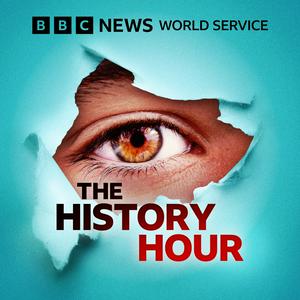
A compilation of the latest Witness History programmes.
Podcast-WebsiteHöre The History Hour, Terra X History - Der Podcast und viele andere Podcasts aus aller Welt mit der radio.de-App
Hol dir die kostenlose radio.de App
- Sender und Podcasts favorisieren
- Streamen via Wifi oder Bluetooth
- Unterstützt Carplay & Android Auto
- viele weitere App Funktionen
Hol dir die kostenlose radio.de App
- Sender und Podcasts favorisieren
- Streamen via Wifi oder Bluetooth
- Unterstützt Carplay & Android Auto
- viele weitere App Funktionen
The History Hour
Code scannen,
App laden,
loshören.
App laden,
loshören.
The History Hour: Zugehörige Podcasts
 Deutschland