

Höre diesen Podcast kostenlos in der App: Kostenlos im App Store laden
radio.de
Sleeptimer
Sender speichern
30 Episoden
How Mosquitoes Shaped History | ft. JACOB!!
16.09.2026 | 1 Std. 37 Min.Mosquitoes are the deadliest animal on Earth and they've been shaping human history since long before recorded time. This week, Delaney sits down with SPILLED. team member Jacob to trace malaria's fingerprints across evolution, colonization, the slave trade, the British Empire, and a WWII research push second only to the Manhattan Project. Two vaccines later, they're still winning. Hosted on Acast. See acast.com/privacy for more information.More Than Mulan: A History of Cross-Dressing for War
20.08.2026 | 57 Min.We're covering seven real female warriors and soldiers across four continents and almost 1,900 years of history — women who disguised themselves as men to fight, and women who didn't have to. Featuring Hannah Snell (the British soldier who enlisted to hunt down her husband), Sarah Rosetta Wakeman (a Civil War soldier who kept her secret to the grave), Nadezhda Durova (the Russian cavalry officer awarded the St. George Cross), the Trung sisters (who led an army of 80,000 to overthrow Han China), Mai Bhago (the Sikh warrior who turned back an army of deserters), and Yaa Asantewaa (the Ashanti queen mother who led her people to war). Plus: what Deborah Sampson's story has in common with all of them.
A history podcast episode on women warriors, female soldiers, and women in war — from the American Revolution and the Civil War to the Napoleonic Wars, the Mughal-Sikh Wars, and the Ashanti Empire.
Sources:
Hannah Snell:
Hannah Snell — Wikipedia: en.wikipedia.org/wiki/Hannah_Snell
Forces News: “Hannah Snell, A Female Soldier In Disguise”
Royal Marines History: “Hannah Snell Joins the Marines, 1747”
British Tars, 1740–1790: “Hannah Snell, A Woman and a Marine”
The Hunterian Blog: “Hannah Snell — Cross Dressing in the 1700s”
Academic: “Body and Gender Expressed by the Cross-Dressing of Hannah Snell…” (Academia.edu)
Primary: Robert Walker (attrib.), The Female Soldier; or, The Surprising Life and Adventures of Hannah Snell (1750)
Deborah Sampson:
American Battlefield Trust: Deborah Sampson
National Women's History Museum: Deborah Sampson
Massachusetts Historical Society: “Deborah Sampson, Soldier in Disguise”
Paul Revere House: “Quitting the Male Habit” (Revere's 1804 pension letter, digitized at MHS)
Historic New England: “Deborah Sampson, Fighting for Recognition”
Just Teach One: The Female Review (1797) — annotated teaching edition
Hanna Lauren Kawamoto, The Female Soldier: Gender Performance and National Identity (UC Irvine MA thesis, 2025) — open access, escholarship.org/uc/item/5wr4x7h5. Covers Sampson plus Margaret Cochran Corbin & Anna Maria Lane.
Georgina K. Lock, “Honouring the Wound…” Linguaculture, Issue 2 (2011) — open access, covers Snell & Sampson plus Pauline Cushman.
Sarah Rosetta Wakeman:
American Battlefield Trust: Sarah Rosetta Wakeman
Sarah Rosetta Wakeman — Wikipedia
Emerging Civil War: “From History's Shadows — Sarah Rosetta Wakeman”
Lauren Cook Burgess, ed., An Uncommon Soldier: The Civil War Letters of Sarah Rosetta Wakeman… (Oxford University Press, 1994)
DeAnne Blanton & Lauren M. Cook, They Fought Like Demons: Women Soldiers in the American Civil War (LSU Press, 2002)
Nadezhda Durova:
Reddit r/badhistory writeup on Durova scholarship [non-historian source — use with caution]
Ruth Averbach, “The Unmaking of a Man: Aleksandr Aleksandrov/Nadezhda Durova,” Slavic Review (Cambridge Core)
UBC lecture on Soviet-era erasure of the gender identity question (open.library.ubc.ca)
Primary: Nadezhda Durova, The Cavalry Maiden (memoir, various translated editions)
Trung Sisters:
Primary: Book of the Later Han (Fan Ye, 5th c.); Dai Viet Su ky toan thu (Ngo Si Lien, 15th c.)
Keith Weller Taylor (Cornell) — commentary on women's status and the disputed Thi Sach execution narrative [locate specific published piece before recording]
Mai Bhago:
General Sikh history sources — record is thin and contested; flag on air. Recommend a targeted search for Sikh studies journal articles on Mai Bhago / Chali Mukte before recording if a stronger citation is needed.
Synthesis / Institutional Context:
“Monstrous Regiment” — History Today (1793 French decree)
“Women and Military Institutions in Early Modern Europe: A Reconnaissance,” Signs journal
Rudolf Dekker & Lotte van de Pol, The Tradition of Female Transvestism in Early Modern Europe (Macmillan, 1989) — open access copy at Erasmus University repository (repub.eur.nl/pub/16934)
Hosted on Acast. See acast.com/privacy for more information.Human Sacrifice | not just the Aztecs
06.08.2026 | 1 Std. 4 Min.Human sacrifice gets a bad rap in the history books, and we're here to spill the tea. This week we're digging into who was really practicing ritual sacrifice across history. From Mesopotamia's royal tombs to Aztec blood debts, Celtic wicker men to Japanese seppuku and why the "savage civilization" narrative doesn't hold up.
Sources:
General / Context:
Caldararo, Niccolo. "Human Sacrifice, Capital Punishment, Prisons & Justice." Historical Social Research 41, no. 4 (2016): 322–46.
Løvschal et al. "Human Sacrifice and Value." Antiquity 93, no. 370 (2019).
Schwartz, Glenn M. "The Archaeological Study of Sacrifice." Annual Review of Anthropology 46 (2017): 223–240.
Mesopotamia / Ur:
Recht, Laerke. "Human Sacrifice in the Ancient Near East and Egypt." The Ancient Near East Today 8, no. 2 (2020).
Egypt:
Campbell, Roselyn Anne. Kill Thy Neighbor: Violence, Power, and Human Sacrifice in Ancient Egypt. PhD diss., UCLA, 2019.
Nielsen, Nicky. "In Ancient Egypt, Human Sacrifice and Shabti Figures Ensured an Afterlife of Servitude." Atlas Obscura, October 17, 2023.
Celtic / Druid / Greco-Roman:
Caesar, Julius. The Conquest of Gaul. Translated by F. P. Long, 2005.
Allen, Stephen. Celtic Warrior — 300 BC–AD 100. Osprey Publishing, 2001.
Davies, John. The Celts: Prehistory to Present Day. Sterling Publishing, 2005.
"Human Sacrifice." Digital Medievalist, Opinionated Celtic FAQs. digitalmedievalist.com
Aztec:
Pennock, Caroline Dodds. "Mass Murder or Religious Homicide?" Historical Social Research 37, no. 3 (2012): 276–302.
Neiburger, E. J. "The American Ball Game Court." Central States Archaeological Journal 62, no. 2 (2015): 74–77.
Japan:
Roberts, Michael, and Arthur Saniotis. "Introduction: Empowering the Body and 'Noble Death.'" Social Analysis 50, no. 1 (2006): 7–24.
India:
BBC News. "India Outrage after Man Acquitted over Wife's Sati Death." September 10, 2024.
Chakravorty, Ranes C. "British Abolish Suttee in India." EBSCO Research Starters, 2023.
Dhungel, Suraj. "Sati System in Hinduism." Academic Voices 8 (2018): 95–99.
The New York Times. "Suttee in India Still Occurs Despite British Prohibition." January 1, 1928.
Hosted on Acast. See acast.com/privacy for more information.The Founding MOTHERS: Women of the American Revolution
08.07.2026 | 58 Min.Paul Revere gets all the glory, but he wasn't the only one riding through the night to save the American Revolution. This Fourth of July, Delaney and Kendyl are spilling the tea on the women history left out of the story: 16-year-old Sybil Ludington, who rode twice as far as Paul Revere through a rainstorm to warn the Continental Army; Deborah Sampson, who disguised herself as a man to fight in combat and removed a musket ball from her own leg; and Abigail Adams, the original "Mrs. President," who ran the family finances, advised a president, and told her husband to "remember the ladies." In honor of the 250th anniversary of the Declaration of Independence, we're giving America's founding mothers the credit — and the chaos — they deserve. Happy Fourth of July, besties.
Sources:
Sybil Ludington:
Hunt, Paula D. "Sybil Ludington, the Female Paul Revere: The Making of a Revolutionary War Heroine." The New England Quarterly 88, no. 2 (2015): 187–222. http://www.jstor.org/stable/24718670
American Battlefield Trust. "Sybil Ludington." https://www.battlefields.org/learn/biographies/sybil-ludington
Smithsonian Magazine. "Did the Midnight Ride of Sibyl Ludington Ever Happen?" March 2022. https://www.smithsonianmag.com/history/did-midnight-ride-sibyl-ludington-ever-happen-180979557/
Deborah Sampson:
Young, Alfred F. Masquerade: The Life and Times of Deborah Sampson, Continental Soldier. New York: Vintage Books, 2004. [Definitive scholarly biography]
Mann, Herman. The Female Review: Life of Deborah Sampson, the Female Soldier in the War of Revolution. 1797. [Primary source, published during her lifetime]
Massachusetts Historical Society. Letter from Paul Revere to William Eustis, February 20, 1804. https://www.masshist.org/database/326
National Women’s History Museum. "Deborah Sampson." Michals, Debra. 2015. https://www.womenshistory.org/education-resources/biographies/deborah-sampson
Museum of the American Revolution. "Biography of Deborah Sampson." https://www.amrevmuseum.org/collection/biography-of-deborah-sampson
George Washington’s Mount Vernon. "Deborah Sampson." https://www.mountvernon.org/library/digitalhistory/digital-encyclopedia/article/deborah-sampson
American Battlefield Trust. "Deborah Sampson." https://www.battlefields.org/learn/biographies/deborah-sampson
Paul Revere House. "Quitting The Male Habit: Paul Revere and Deborah Sampson’s Appeal for a Military Pension." https://www.paulreverehouse.org/quitting-the-male-habit-paul-revere-and-deborah-sampsons-appeal-for-a-military-pension/
Abigail Adams:
Shields, David S. and Fredrika J. Teute. "The Court of Abigail Adams." Journal of the Early Republic 35, no. 2 (2015): 227–35. http://www.jstor.org/stable/24486730
Britannica. "Abigail Adams." https://www.britannica.com/biography/Abigail-Adams
Miller Center. "Abigail Adams." https://millercenter.org/president/adams/adams-1797-abigail-firstlady
National Women’s History Museum. "Abigail Smith Adams." https://www.womenshistory.org/education-resources/biographies/abigail-adams
Hosted on Acast. See acast.com/privacy for more information.Should You Trust a Short King? Leprechauns & Irish Folklore
16.06.2026 | 1 Std. 7 Min.You've been lied to by Lucky Charms. The leprechaun you know — jolly, green, guarding gold at the end of a rainbow — is about 150 years old. The leprechaun from Irish folklore is about 1,300 years old, and they are not the same creature.
This week we're tracing how the original lucharpán went from a fearsome red-coated water sprite who'd drag a sleeping king into the sea, to the cereal-box mascot Americans invented in the 1840s. We get into the medieval Celtic oral tradition, the professional storytellers who kept it alive, the pot of gold as a lesson about human greed, and how Irish immigration during the potato blight turned a misunderstood trickster into a symbol of Irish pride.
New episodes every other Tuesday. 🍀
🎧 Share it with a friend — 40% of podcast discovery is still word of mouth.
📚 Books we mention live on the Spilled Bookshop: https://bookshop.org/shop/SPILLED
Academic & Institutional Sources:
EBSCO Research Starter: "Leprechauns."
Oí Giolláin, Diarmuid. "The Leipreachán and Fairies, Dwarfs and the Household Familiar: A Comparative Study." Béaloideas 52 (1984): 75–150. https://doi.org/10.2307/20522237
Winberry, John J. "The Elusive Elf: Some Thoughts on the Nature and Origin of the Irish Leprechaun." 1976.
Mulligan, William H., Jr. "Review: Alive and Well: New Perspectives on Irish America." 2012.
National Folklore Collection, University College Dublin (UNESCO Memory of the World Register). Primary source accounts. https://www.duchas.ie
Primary Sources Referenced:
"The Adventure of Fergus Son of Léti" (8th century). Earliest known reference to the luchorpán.
"The Death of Fergus" (13th–14th century). Lupracan civilization account.
Lover, Samuel. Legends and Stories of Ireland. 1831.
Croker, Thomas Crofton. Fairy Legends and Traditions of The South of Ireland. 1825.
Hardy, Philip Dixon. 1837 description. Referenced via Oí Giolláin (1984).
Mr and Mrs Hall. 1843 account. Referenced via Oí Giolláin (1984).
O’Donnell, Edward T. 1001 Things Everyone Should Know About Irish American History.
Yeats, W.B. Fairy and Folk Tales of the Irish Peasantry. [Referenced for solitary vs trooping fairy color distinction]
General Reference:
"The Jolly Leprechaun’s Sinister Origins." History.com.
"Leprechaun: From Gold-Loving Cobbler to Cultural Icon." PBS.
The Pale Horse Substack: "In Red Caps and Green Coats" and "The Leprechaun: From Trickster to Icon." Note: not peer-reviewed. Used for thematic framing only, not factual claims.
Wikipedia: "Slieve Foy" entry. Used to verify EU protection date (2009).
Hosted on Acast. See acast.com/privacy for more information.
Weitere Comedy Podcasts
 Gemischtes HackComedy, Gesellschaft und Kultur
 Baywatch BerlinComedy, Gesellschaft und Kultur, TV und Film
 Die NervigenComedy, Gesellschaft und Kultur
 Edeltalk - mit Dominik & KevinComedy
 Mit den Waffeln einer FrauComedy
 Kalk & Welk - Die fabelhaften Boomer BoysComedy
 HobbylosComedy, Freizeit, Gesellschaft und Kultur, Hobbys
 Kaulitz Hills - Senf aus HollywoodComedy
 Bratwurst und Baklava - mit Özcan Cosar und Bastian BielendorferComedy, Gesellschaft und Kultur, Stand-Up-Comedy
 Fest & FlauschigComedy, Gesellschaft und Kultur
Trending Comedy Podcasts
 REDE.Comedy, Impro-Comedy
 WDR 5 Satire DeluxeComedy
 Friday Night Comedy from BBC Radio 4Comedy
 Sebastian Lehmann – ElternzeitComedy
 Einen zu vielComedy, Gesellschaft und Kultur
 Couple OfBeziehungen, Comedy, Freizeit, Gesellschaft und Kultur
 Dick&Doof minisComedy
 Nachsitzen mit Herr SchröderComedy, Comedy-Interviews
 Baborie & Rakers – Was war los gewesen?Comedy, Freizeit
 Hi FreaksComedy
 Adoptivbrüder – mit Hannes & JeremyComedy, Gesellschaft und Kultur
 Stößchen • by Roman und Daniel NawrotBeziehungen, Comedy, Gesellschaft und Kultur, Kinder und Familie, TV und Film
 Hawi D'EhreComedy, Freizeit
 Baumann und Clausen - RadiofolgenBelletristik, Comedy, Comedy-Fiction
 Taskmaster The PodcastComedy, Filmrezensionen, TV und Film
 Off Menu with Ed Gamble and James AcasterComedy, Comedy-Interviews
 Bin ich das Arschloch?Comedy, Impro-Comedy
 Bayerns Most WantedComedy
 The Daily Show: Ears EditionComedy, Nachrichten, Nachrichten des Tages
 Schreiben & SchreddernBücher, Comedy, Gesellschaft und Kultur, Kunst, Persönliche Geschichten
 NotAufnahme – die lustigsten PatientengeschichtenComedy, Comedy-Interviews, Gesellschaft und Kultur, Wirtschaft
 Frühstück bei BarbaraComedy, Freizeit, Gesellschaft und Kultur
 DAS PODCAST UFOComedy
 Zwei VermengteComedy
 The Basement YardComedy, Impro-Comedy
Über SPILLED.
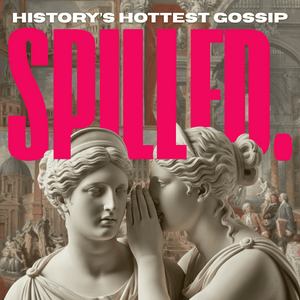
Kendyl and Delaney Florence are bringing you history’s hottest gossip, every other Tuesday. SPILLED. brings you the tea you didn’t know you needed through a light-hearted and (somewhat) educational podcast on historic scandals, betrayals, rumors, and more. Each episode will focus on a new - well, old - story that will leave you with the coolest fun facts at your next dinner party. Join us to make history a bit more fun, and a lot juicier.Business Inquiries: spilledhistory@gmail.com Hosted on Acast. See acast.com/privacy for more information.
Podcast-WebsiteHöre SPILLED., Gemischtes Hack und viele andere Podcasts aus aller Welt mit der radio.de-App
Hol dir die kostenlose radio.de App
- Sender und Podcasts favorisieren
- Streamen via Wifi oder Bluetooth
- Unterstützt Carplay & Android Auto
- viele weitere App Funktionen
Hol dir die kostenlose radio.de App
- Sender und Podcasts favorisieren
- Streamen via Wifi oder Bluetooth
- Unterstützt Carplay & Android Auto
- viele weitere App Funktionen

SPILLED.
Code scannen,
App laden,
loshören.
App laden,
loshören.
 Deutschland