

Höre diesen Podcast kostenlos in der App: Kostenlos im App Store laden
radio.de
Sleeptimer
Sender speichern
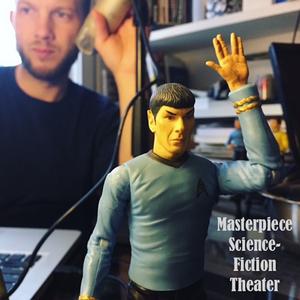
Masterpiece Science-Fiction Theater
Justin Scott Snead: Writer, English Teacher, Star Trek Fan
Neueste Episode
40 Episoden
StarTrek01.34–Post Season 1 Analysis Part 3: Diversity and Inclusivity
24.02.2022 | 1 Std. 3 Min.In this episode:
This is an audio version of my essay, The Enterprise is not a White Space: why minority representation on Star Trek was so radical and risky in the 1960s.
Much of American society, including genre TV and film, has historically been cordoned off into white spaces, which is a term coined by Sociologist Elijah Anderson to describe spaces predominantly filled with white people and where Black people are treated as outsiders. In its earliest years, Star Trek showed its audience that it was not a white space, but a diverse and inclusive space.
To prove the point, my article is a deep dive into casting choices and the creative input of Black actors in Star Trek’s first season. There is more to the story than Uhura and Sulu, as important as those iconic roles are. People of color were chosen as background extras, small speaking roles, and guest stars. Using analysis and many images, my article celebrates unheralded roles like these:
They all made an impact since even the smallest role kept the Enterprise from being considered a white space. Every week of the 1966-67 television season except for one, you would have tuned in to see Black and brown people in uniform on board a starship.
Sections:
Explanation of Anderson’s thesis on white and Black spaces; brief survey of Jim Crow laws that were being passed in the 1960s
Background Extras
Speaking Guest Roles
Guest StarsStarTrek 01.33–Post Season 1 Analysis Part 2: World Building
18.04.2020 | 31 Min.In this episode: A complete analysis of World Building in Season One of Star Trek The Original Series:
A Survey of all strange new worlds (30) and all new life forms and civilizations (25)
A breakdown of categories for each, from barren desolate planets to advanced ones, and primitive aliens to evolved non-corporeals
The State of the Star Trek Universe after only one season: it truly is the final frontier, visiting no member worlds and only 5 Federation colonies–four of which ended in bloodshed and disaster!Star Trek 01.32–Post-Season 1 Analysis Part 1: Narrative Structure
30.01.2020 | 51 Min.In this episode:
The first part of our post-season 1 analysis of Star Trek: The Original Series, with a focus on trends in narrative structure.
Antagonist Type: There are more monster episodes than you might think, but the monsters and the villains are depicted in unconventional ways.
Monster: 11/28 (39.2%)
Villain: 9/28 (32.1%)
Computer: 4/28 (14.2%)
Other: 6/28 (21.4%)
Science Fiction Element Spectrum: Only a quarter of episodes are heavy science-fiction; while more than a third have only one notable Sci-fi element
Above Average (4+ elements)
1. Where No Man Has Gone Before (4)
9. What are Little Girls Made of? (4)
29. Operation Annihilate (4)
20.The Alternative Factor (5)
28. The City on the Edge of Forever (5)
15-16. The Menagerie (6)
22.The Return of the Archons (8)
Below Average (1-2 elements)
3. Mudd’s Women(1)
10. Dagger of the Mind (1)
12 The Conscience of the King(1)
14. Court Martial(1)
27. Errand of Mercy(1)
4. The Enemy Within (2)
6. The Naked Time (2)
7. Charlie X (2)
21.Tomorrow is Yesterday(2)
26. The Devil in the Dark(2)
Average (3 elements)
2. The Corbomite Maneuver
5. The Man Trap
8. Balance of Terror
11. Miri
13. The Galileo Seven
17. Shore Leave
18. The Squire of Gothos
19.Arena
23. Space Seed
24. A Taste of Armageddon
25. This Side of Paradise
Conflict Resolution: A strong majority of the episodes end with the character coming up with clever solutions to get them out of their problem
Wits: 12 (43%) (75%)
Wits & Fists: 9 (32%)
Fists: 4 (14.2%)
Other: 3 (10%)StarTrek 01.31–Operation: Annihilate!
03.10.2019 | 31 Min.In this episode:
an analysis of “Operation: Annihilate!” the last aired episode of Season One of Star Trek
a fitting season finale (even though 60s TV did not really do those as we understand them) because it has a grand scale and important character development for all three leads–Kirk, Spock and McCoy–which is unusual
a strong science-fiction outing with an alien that spreads “mass insanity” throughout the galaxy–and they look like flying jellyfish.StarTrek01.30–The City on the Edge of Forever
02.09.2019 | 56 Min.In this episode:
An analysis of The City on the Edge of Forever:
How the episode still lives up to the hype five decades later
Edith Keillor voices Star Trek’s Mission Statement, and is a stand in for all Star Trek fans
A comparison with Ellison’s script–the good, the bad and the ugly–especially Keillor, whom Ellison wrote as a Pentecostal evangelical crossed with L. Ron Hubbard. Hint: the filmed version is better.
Weitere Bücher Podcasts
 Sherlock Holmes KurzgeschichtenBelletristik, Bücher, Drama, Kunst
 eat.READ.sleep. Der Podcast, der das Lesen feiert.Bücher, Kunst
 Geschichten aus dem Eberkopf - Ein Harry Potter Hörspiel-PodcastBelletristik, Bücher, Kunst
 Zwei Seiten - Der Podcast über Bücher | WDRBücher, Kunst
 Was liest du gerade?Bücher, Kunst
 Einschlafen mit BüchernBücher, Kunst
 Lies und das - der Podcast für alle, die gerne Bücher lesenBücher, Kunst
 WDR 5 Sherlock Holmes Detektivgeschichten - HörbuchBücher, Kunst
 Jan Weiler: Mein Leben als MenschBücher, Kunst
 #AusgelesenBücher, Kunst
Trending Bücher Podcasts
 Orte und WorteBücher, Kunst
 Lesedusche. Klassiker erfrischend andersBücher, Kunst
 blauschwarzberlin - Der LiteraturpodcastBücher, Gesellschaft und Kultur, Kunst, Nachrichten, Unterhaltungs-News
 Lord of the Rings Lorecast - J.R.R. Tolkien's World & Writings ExplainedBelletristik, Bücher, Kunst, TV und Film
 Feiste BücherBücher, Kunst
 Seitenweise GlückBücher, Freizeit, Gesellschaft und Kultur, Hobbys, Kunst
 Between The Covers : Conversations with Writers in Fiction, Nonfiction & PoetryBelletristik, Bücher, Kunst
 Der Königsmörder-PodcastBücher, Comedy, Kunst
 Read With Me: White Nights by Fyodor DostoevskyBücher, Kunst
 The Waterstones PodcastBücher, Kunst
 Herbst TapesBücher, Gesellschaft und Kultur, Kunst
 Blourish & Flotts: Beautifully RetoldBücher, Kunst
Über Masterpiece Science-Fiction Theater
A Podcast that Applies Literary Analysis to Classic Sci-Fi Shows & Movies
Podcast-WebsiteHöre Masterpiece Science-Fiction Theater, Sherlock Holmes Kurzgeschichten und viele andere Podcasts aus aller Welt mit der radio.de-App
Hol dir die kostenlose radio.de App
- Sender und Podcasts favorisieren
- Streamen via Wifi oder Bluetooth
- Unterstützt Carplay & Android Auto
- viele weitere App Funktionen
Hol dir die kostenlose radio.de App
- Sender und Podcasts favorisieren
- Streamen via Wifi oder Bluetooth
- Unterstützt Carplay & Android Auto
- viele weitere App Funktionen
Masterpiece Science-Fiction Theater
Code scannen,
App laden,
loshören.
App laden,
loshören.
 Deutschland