
Höre diesen Podcast kostenlos in der App: Kostenlos im App Store laden
radio.de
Sleeptimer
Sender speichern
8 Episoden
7.0 The Trust IS a Feeling (and Closing Thoughts) Episode
21.07.2026 | 12 Min.Trust Control is the culmination of more than 10 months of human, non-AI assisted exploration and process. It is the product of deep research rabbit hole digging; journalistic interviews; idea organizing; contemplation and articulation; writing and re-writing; re-re-writing; microphone jabber; digitized audio manipulation; more contemplation and articulation; re-re-re-writing and re-recording; and...well...you get the picture.
The project took many twists and turns along the way. In this episode, you'll hear a bit about Trust Control creator Kate Kaye's process and some of the overarching ideas that emerged from inside her (humble, fallible and messy) human brain.
In this episode:
The power and meaning of trust as unarticulated alchemy
Why and how Trust Control evolved as an artistic and philosophical endeavor
Unexpected trust measurement patterns discovered
A look ahead to full-length Trust Control interview episodes and related work
People Featured in this Episode:
Kate Kaye, Trust Control creator and narrator
Key Reference
What Art Does: An Unfinished Theory by Brian Eno and Bette A. (Adriaanse)
(also see the authors speak about the book here.)6.0 The New Trust Paradigm Episode: Scoring Trustworthiness of Human and AI Agent "Workers"
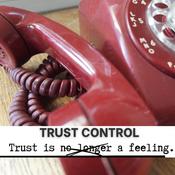
21.07.2026 | 57 Min.TRUST CONTROL: Trust is no longer a feeling.
6.0 The New Trust Paradigm Episode: Scoring Trustworthiness of Human and AI Agent "Workers"
It's starting to happen at work and inside a blockchain-based online dispute resolution platform: A new trust paradigm is unfolding in which the technical trust measures needed by computers and bots are beginning to seep into human ideas of trust. Some people believe we're already on a trajectory toward continuous, machine-readable trust scores and "continuous proof of humanity." Indeed, some say that "trust is no longer a feeling."
Business and tech consultancies like McKinsey and Company say AI agents are workers, just like human employees. And that means humans will be forced to prove their trustworthiness using the same computational trust signals bots like Eudamon, Reefwatcher and the other AI agents featured in the first episode of Trust Control are measured by. Indeed, the lines are blurring.
In this episode:
Agentic trust scoring startups
The demand for continuous, machine readable trust scoring of agents and humans
Questioning assumptions of transparency-based blockchain trustworthiness
The future of AI agent juries and judges in blockchain dispute resolution "courtrooms"
People Featured in this Episode:
Kate Kaye, Trust Control creator and narrator
Michael Fauscette, Founder, CEO and Chief Analyst of Arion Research
Cemre Çise Kadıoğlu Kumtepe, Assistant Professor, Department of Information and Technology Law, Ankara University, Türkiye
Key References (Mostly) in Order of Appearance
PART ONE
Benchmarking real-time trust scoring across five AI Agent architectures
CleanLab
2025
See also: Handshake acquires CleanLab (2026)
The agentic organization: Contours of the next paradigm for the AI era
McKinsey and Company
2025
State of AI trust in 2026: Shifting to the agentic era
McKinsey ad Company
2026
Building the Digital Workforce
by Michael Fauscette
2025
PART TWO
European Union Digital Services Act
Article 21
2022
See also: Out-of-court dispute settlement bodies under the Digital Services Act (DSA)
Kleros in the Agentic Society: AI Jurors, Kill Switches & the Future of Dispute Resolution
Kleros
2026
Unpacking the technology of trust: establishing trust and fairness in online dispute resolution through blockchain and smart contracts
International Journal of Law and Information Technology
by Cemre Çise Kadıo?lu Kumtepe
2025
Due Process in Blockchain Dispute Resolution Theory and Compliance
by Cemre Çise Kadıo?lu Kumtepe
2026
Unveiling the Kleros Court MCP Server
(see Use Case 1: Automated Due Diligence Agent)
Skywork
2025
Schelling Points: Why Kleros Jurors Converge on the Truth
Kleros
2026
Thomas Schelling, Nobel Laureate and Longtime RAND Consultant, Dies at 95
Rand
2016
The Strategy of Conflict Prospectus for a Reorientation of Game Theory
by Thomas C. Schelling
The Journal of Conflict Resolution
1958
Trust and Suspicion
by Morton Deutsch
Journal of Conflict Resolution
1958 The effect of motivational orientation upon trust and suspicion
by Morton Deutsch
Human Relations
1960
PART THREE
Evaluations for the agentic world
Agentic AI from QuantumBlack, AI by McKinsey
2026
iTWire TV interview with Lakshmi Hanspal, Digicert
2026
Trust Control Credits
Trust Control was researched, written, edited and produced by Kate Kaye. All interviews with sources featured in Trust Control were conducted by Kate unless otherwise noted.
Fake ads and silly satire was voiced by Kate Kaye and/or Kyle Huth
Music
The tunes featured throughout Trust Control were written by D. Rives Curtright and performed by the band Epic Strange from Trust Control's home of Portland, Oregon:
D. Rives Curtright: guitar, baritone sax, percussion and drum machine
Charlie Gotgart: bass
Steven Francisco: midi keys
Octavio Dowling: keys
Dave Coniglio: drums and vibraphone
Mike McGovern: bass on Decimation
Hear the full Epic Strange album, Nouveau Electric Mess, on Soundcloud. Hear music from D. Rives Curtright on Spotify.
The work that went into Trust Control was done in Kate Kaye's personal time and was supported by Oregon State University's Patricia Valian Reser Center for the Creative Arts fellowship on Trust in the Age of Generative AI and Oregon Humanities.5.0 The Measuring Trustworthiness of Media Episode (Part Two: The Limits of Computational Trust)
21.07.2026 | 39 Min.When Brooklyn, New York photographer and entrepreneur Tiffany Walling McGarity crafted stunning portraits of friends using the very old tintype method, she wanted to preserve them, and the provenance of the images, in digital form. But she discovered that a technical method promising trustworthiness through a computational trust approach deemed her work "invalid" and exposed the downsides of technical trust approaches that reinforce existing institutional power structures.
In this episode:
Trustworthiness metadata, media trust signals, and "content credentials"
News industry assumptions about technical media trustworthiness and and authenticity measures
What computational trust measures miss that news journalism consumers care about
The push for a zero trust-style distrust-first approach to media and news and who gets left out
The blurring lines of technical and human trust
People Featured in this Episode
Kate Kaye, Trust Control creator and narrator
Tiffany Walling McGarity, Photographer, Co-founder and CEO of Metapyxl
Tessa Sproule, Director of Metadata and Information Management at the English division of CBC Radio Canada
Lynn Walsh, Journalist, Assistant Director of Trusting News, Chairwoman of the Society of Professional Journalists' Ethics Committee
Key References (Mostly) in Order of Appearance
PART ONE
Tiffany Walling McGarity's Digitized Tintype Photos
Tintype portrait of Matthew Perino
Tintype portrait of Amanda Hollaback
Photography by: Walling McGarity
Both plates poured and processed on location in Brooklyn, NY by Gair Wissenbach
Nous avons été témoins, nous pouvons le prouver
(translation: We have witnessed it, we can prove it.)
Agence France Presse video
2025
Content Credentials (C2PA)
(Also see C2PA technical specifications)
In Post-Authenticity AI Age, Knowledge Institutions Matter More than Ever
By John Wihbey
Tech Policy Press
2025
NYT's Canada Bureau Chief Used AI for Fake Poilievre Quote ft. Michelle Cyca
The North State
2026
Journalism fact-checking is "an infrastructure problem"
LinkedIn Post
Erik Svilich, Encypher CEO
2026
PART TWO
Instagram Photos Are Being Labeled 'Made With AI' When They're Not
By Matt Growcoot
PetaPixel
2024
PART THREE
JPEG Trust
Origin Lens: Reclaiming Trust on the AI-Mediated Web Through On-Device Image Provenance Verification
by Alexander Loth, et al
WebSci Companion '26: Companion Publication of the 2026 18th ACM Web Science Conference
2026
"if you can't prove it's real, it's not."
Comment on LinkedIn Post
2026
Trust Control Credits
Trust Control was researched, written, edited and produced by Kate Kaye. All interviews with sources featured in Trust Control were conducted by Kate unless otherwise noted.
Fake ads and silly satire was voiced by Kate Kaye and/or Kyle Huth
Music
The tunes featured throughout Trust Control were written by D. Rives Curtright and performed by the band Epic Strange from Trust Control's home of Portland, Oregon:
D. Rives Curtright: guitar, baritone sax, percussion and drum machine
Charlie Gotgart: bass
Steven Francisco: midi keys
Octavio Dowling: keys
Dave Coniglio: drums and vibraphone
Mike McGovern: bass on Decimation
Hear the full Epic Strange album, Nouveau Electric Mess, on Soundcloud. Hear music from D. Rives Curtright on Spotify.
The work that went into Trust Control was done in Kate Kaye's personal time and was supported by Oregon State University's Patricia Valian Reser Center for the Creative Arts fellowship on Trust in the Age of Generative AI and Oregon Humanities.4.0 The Measuring Trustworthiness of Media Episode (Part One: Propaganda and Journalism's Trust Assumptions)
21.07.2026 | 45 Min.TRUST CONTROL: Trust is no longer a feeling.
4.0 The Measuring Trustworthiness of Media Episode (Part One: Propaganda and Journalism's Trust Assumptions)
During World War II, the time Carl I. Hovland spent evaluating the effects of U.S. propaganda films on U.S. Army recruits inspired his research measuring information and communication trustworthiness and helped propel the field. Since that time, people have designed all sorts of methods and models in attempts to gauge trustworthiness of media and information. This is the first part of a two-part episode exploring measurement of trustworthiness of media, information, communication, news and even art.
In this episode:
U.S. Army propaganda films and analysis of "the sleeper effect" on perception of information source trustworthiness
Early Cold War inspired U.S. military industrial complex and Rockefeller Foundation funding of trust measurement amid the Red Scare and McCarthyism
Models and methods for scoring and even color-coding trustworthiness of information and news
The historical links between "measuring" the aesthetic value of music and art and measuring media trustworthiness
Why some trustworthiness measurement methods may not cure news journalism's low trust problem
People Featured in this Episode:
Kate Kaye, Trust Control creator and narrator
Tosan Atele-Williams, Academic Associate in the Faculty of Business and IT and Computational Trust Researcher at Ontario Tech University
Lynn Walsh, Journalist, Assistant Director of Trusting News, Chairwoman of the Society of Professional Journalists' Ethics Committee
Matt Skibinski, Newsguard Chief Operating Officer
Key References (Mostly) in Order of Appearance
PART ONE
Why We Fight: The Battle of Britain
U.S. National Archives
1943
Experiments on Mass Communication
by Carl I. Hovland, et al.
Princeton University Press
1949
The Influence of Source Credibility on Communication Effectiveness
by Carl I. Hovland and Walter Weiss
The Public Opinion Quarterly
Winter, 1951-1952
The Measurement of Trust in Communication Research Part 1
by Paola Pascual-Ferrá
Communication Research Trends
Wikipedia models of trust workshop paper Investigations into Trust for Collaborative Information Repositories: A Wikipedia Case Study
by Deborah L. McGuinness, et al
Models of Trust for the Web (MTW'06)
2006
PART TWO
Information Trust Model
by Tosan Atele-Williams and Stephen Marsh
Cognitive Systems Research
2023
Towards a Computational Model of Information Trust
by Tosan Atele-Williams and Stephen Marsh
Trust Management XII
International Federation for Information Processing (IFIP) Advances in Information and Communication Technology
(see p. 124)
2018
infoDNA (Version 2) - Agent Enhanced Trustworthy Distributed Information
by Stephen Marsh
2004
Aesthetic Measure
by George D. Birkhoff
1933
NewsGuard Website Rating Process and Criteria
Trust Control Credits
Trust Control was researched, written, edited and produced by Kate Kaye. All interviews with sources featured in Trust Control were conducted by Kate unless otherwise noted.
Fake ads and silly satire was voiced by Kate Kaye and/or Kyle Huth
Music
The tunes featured throughout Trust Control were written by D. Rives Curtright and performed by the band Epic Strange from Trust Control's home of Portland, Oregon:
D. Rives Curtright: guitar, baritone sax, percussion and drum machine
Charlie Gotgart: bass
Steven Francisco: midi keys
Octavio Dowling: keys
Dave Coniglio: drums and vibraphone
Mike McGovern: bass on Decimation
Hear the full Epic Strange album, Nouveau Electric Mess, on Soundcloud. Hear music from D. Rives Curtright on Spotify.
The work that went into Trust Control was done in Kate Kaye's personal time and was supported by Oregon State University's Patricia Valian Reser Center for the Creative Arts fellowship on Trust in the Age of Generative AI and Oregon Humanities.3.0 The History (and Residue) of Measuring Trust in AI Episode
21.07.2026 | 1 Std. 8 Min.TRUST CONTROL: Trust is no longer a feeling.
3.0 The History (and Residue) of Measuring Trust in AI Episode
Roger C. Mayer and his fellow researchers introduced an influential trust model in 1995 in the Academy of Management Review. The impetus for their work? Corporate managers worried they were losing control of workers amid big changes. There were more people of color and women entering the workforce, plus workers upheaval in emerging self-directed teams could not be monitored as they once were. Little did Mayer and his co-authors James H. Davis and F. David Schoorman know that decades later their ABI (Ability, Benevolence and Integrity) trust model would become heavily influential in trust in AI related research.
This episode of Trust Control is all about the historical ideas and "residue" that perpetuate today throughout trust measurement. Why do we see the same old trust measurement ideas, applied in questionable ways?
In this episode:
Corporate motivations for measuring worker trust and trustworthiness
Why the Mayer ABI model may not be right for AI
How antiquated and sometimes poorly-tested ideas get baked into today's trust measurement
Under- and over-trusting AI
W- E- I -R -D history (Western Educated Industrialized Rich Democratic) of trust measurement
Military funding of trust measurement from the Cold War to today
Featured in this episode:
Kate Kaye, Trust Control creator and narrator
Roger C. Mayer, Professor of Leadership in the Poole College of Management at North Carolina State University
Bran Knowles, Professor of Sociotechnical Systems at Lancaster University, UK
Gale Lucas, Director of the Technology Evaluation Lab at the University of Southern California's Institute for Creative Technologies, Research Associate Professor in USC's Departments of Civil Engineering, Computer Science and Psychology
Meredith McNeil, Senior Research Scientist and Team Leader of the Genome to Phenome Team at Commonwealth Scientific and Industrial Research Organisation (CSIRO), Australia
Andreas Duenser, Research Scientist at Data 61, Commonwealth Scientific and Industrial Research Organisation (CSIRO), Australia
Key References (Mostly) in Order of Appearance
PART ONE
Twenty-four years of empirical research on trust in AI: a bibliometric review of trends, overlooked issues, and future directions
by Michaela Benk, et al
2024
An Integrative Model of Organizational Trust
by Roger C. Mayer, James H. Davis, and F. David Schoorman
1995
The Sanction of Authority: Promoting Public Trust in AI
by Bran Knowles and John T. Richards
FAccT '21: Proceedings of the 2021 ACM Conference on Fairness, Accountability, and Transparency
2021
PART TWO
Designing for Appropriate Reliance in Trust in Automation
by John D. Lee and Katrina A. See
Human Factors and Ergonomics Society
2004
A New Scale for the Measurement of Interpersonal Trust
by Julian Rotter
Journal of Personality
1967
PART THREE
A Novel Method for Trust-Sensitive Design: Applying Conjoint Analysis to Machine-Assisted Genome Annotation
by Melanie McGrath, et al (including Andreas Duenser)
Proceedings of the Extended Abstracts of the CHI Conference on Human Factors in Computing Systems
2025 Measuring trust in artificial intelligence: validation of an established scale and its short form by Melanie McGrath, et al (including Andreas Duenser)
Frontiers in Artificial Intelligence
2025 Task Load Index
by Sandra Hart
NASA Human Performance Research Group
1986
(also see this link)
Participants matter: Effectiveness of VR-based training on the knowledge, trust in the robot, and self-efficacy of construction workers and university students by Pooya Adami, et al including Gale Lucas
Advanced Engineering Informatics
2023
Trust and Suspicion
by Morton Deutsch
Journal of Conflict Resolution
1958 The Original Prisoner's Dilemma Game distributed at 1950 Stanford University event
(originally called "A Two*Person Dilemma")
A.W. Tucker
1950
More info here
Foundations for an empirically determined scale of Trust in Automated Systems
by Jiun-Yin Jian, et al
Center for Multisource Information Fusion
Department of Industrial Engineering
State University of New York at Buffalo
1998
(Also published in the International Journal of Cognitive Ergonomics, 2000)
Trust Control Credits
Trust Control was researched, written, edited and produced by Kate Kaye. All interviews with sources featured in Trust Control were conducted by Kate unless otherwise noted.
Fake ads and silly satire was voiced by Kate Kaye and/or Kyle Huth
Music
The tunes featured throughout Trust Control were written by D. Rives Curtright and performed by the band Epic Strange from Trust Control's home of Portland, Oregon:
D. Rives Curtright: guitar, baritone sax, percussion and drum machine
Charlie Gotgart: bass
Steven Francisco: midi keys
Octavio Dowling: keys
Dave Coniglio: drums and vibraphone
Mike McGovern: bass on Decimation
Hear the full Epic Strange album, Nouveau Electric Mess, on Soundcloud. Hear music from D. Rives Curtright on Spotify.
The work that went into Trust Control was done in Kate Kaye's personal time and was supported by Oregon State University's Patricia Valian Reser Center for the Creative Arts fellowship on Trust in the Age of Generative AI and Oregon Humanities.
Weitere Geschichte Podcasts









Trending Geschichte Podcasts













Über Trust Control
Trust Control is a documentary podcast series about the weird yet surprisingly expansive world of trust measurement from investigative journalist and researcher Kate Kaye. Based on nearly a year of deep research and interviews with a wide variety of sources, the show takes listeners on a journey from the post-World War II Cold War period into the early days of the Internet through to today's agentic AI era. Trust – how it is measured, by whom and for what purposes – is the thread that carries us along throughout. Episodes dig into measurement of trust in AI and automation; media, news and information trustworthiness; the emerging realm of human and AI agent "worker" trust scoring, U.S. military and corporate management funding and influence in trust measurement, and more. Part historical documentary, part philosophical analysis, part provocative (and admittedly hokey) satire, Trust Control explores an emerging trust paradigm happening just below the surface of our digital lives… bubbling up to the surface of our real ones.
Podcast-WebsiteHöre Trust Control, The Rest Is History und viele andere Podcasts aus aller Welt mit der radio.de-App
Hol dir die kostenlose radio.de App
- Sender und Podcasts favorisieren
- Streamen via Wifi oder Bluetooth
- Unterstützt Carplay & Android Auto
- viele weitere App Funktionen
Hol dir die kostenlose radio.de App
- Sender und Podcasts favorisieren
- Streamen via Wifi oder Bluetooth
- Unterstützt Carplay & Android Auto
- viele weitere App Funktionen
Trust Control
Code scannen,
App laden,
loshören.
App laden,
loshören.
Trust Control: Zugehörige Podcasts
 Deutschland

