

Höre diesen Podcast kostenlos in der App: Kostenlos im App Store laden
radio.de
Sleeptimer
Sender speichern
134 Episoden

Jev: The AI That Makes Decisions, Not Text - and Why It Changes Everything (Diogo Almeida)
15.10.2026 | 1 Std. 7 Min.What is Jev? TypeSafe’s Jev is a new kind of AI model, a “decision model,” that doesn’t write text. It makes fast, cheap, calibrated decisions inside software, and it has taken the AI world by storm: within weeks of launch it became the most copied model in AI, with OpenAI, Cloudflare, Amazon and Databricks all shipping their own versions, and TypeSafe just raised an $870 million Series A at a $7.5 billion valuation. In this episode, Jev’s creator Diogo Almeida, co-inventor of RLHF at OpenAI and now CEO of TypeSafe, explains Jev in plain English: what a “System One” or decision model actually is, why ChatGPT-style language models can’t be trusted inside software (“95% Einstein, 5% Mr. Bean”), how RLHF and RLVR created the problem, what RLCD (reinforcement learning for calibrated decisions) does differently, where the training data comes from, which models Jev is built on, why “just a classifier” is a compliment, and why he calls pre-training “a giant dumpster fire of wasting resources.”
We also cover the copycats and why he thinks they missed the hard part, why benchmarks are useless, whether Jev will go open source, the Jevons paradox business model behind the name, why he doesn’t believe AI is on the path to recursive self-improvement, and why he thinks the AI winter he feared has been averted.
(00:00) Cold open & Intro: “95% Einstein, 5% Mr. Bean”
(01:09) Jev’s breakout launch: why intelligence per dollar matters
(03:25) Why TypeSafe built in stealth for two years
(05:50) “We could have had AGI last year”
(06:48) Why the product carries the marketing
(09:33) What is Jev? Machine-native AI, built for software
(10:53) System One vs. System Two: the limits of reasoning
(12:26) From simple decisions to composable AI
(15:21) Automating email: giant prompts vs. smart if-statements
(20:03) Probabilities, thresholds, and developer control
(23:43) Why Jev is faster and cheaper than chat models
(25:39) “Classification is AI-complete”
(27:16) RLHF: how OpenAI trained models to please humans
(31:28) Sycophancy, refusals, and the hidden costs of RLHF
(34:22) RLVR: why benchmark gains don’t mean reliable automation
(37:51) RLCD: optimizing for machine-native intelligence
(39:54) Why TypeSafe builds its training data in-house
(41:49) The Bitterest Lesson: define the task before scaling
(44:39) Building Jev from open-weight models
(45:56) Is Jev just a classifier? Why that’s a compliment
(48:35) “Build prod, not God”
(50:11) Embedding AI in software, beyond coding assistants
(53:05) Jev’s copycats: matching the interface vs. the intelligence
(55:33) Why benchmarks mislead the users they should help
(58:37) Open weights vs. APIs: how TypeSafe weighs the tradeoff
(1:00:04) Jevons paradox: a new market for machine intelligence
(1:02:50) Why Diogo is skeptical of recursive self-improvement
(1:04:47) Can practical automation avert an AI winter?What Happens When Billions of AI Agents Hit Your Database? (Andy Pavlo)
08.10.2026 | 1 Std. 16 Min.AI agents are becoming the biggest users of databases: creating them, querying them, and sometimes deleting them. Andy Pavlo, Carnegie Mellon's database professor and now VP of Database Research at ClickHouse, explains what changes when billions of agents hit the data layer, and why most of the AI world's mental model of databases stopped at vector databases and RAG.
Andy's CMU courses taught a generation of engineers (and, it turns out, the AI models); he writes the year-in-review on databases the whole industry reads; and this summer he joined ClickHouse to found ClickHouse Labs. We cover why vector databases were "just an index," what it means for an agent to create a database, why agents could mean 10 to 100x more queries, whether files or databases should hold an agent's memory, how text-to-SQL went from 60% to 99.5% accuracy, why 60% of open-source databases now have commits from coding agents, and what ten years of self-driving database research taught him. Plus ClickHouse, Postgres, the vector/graph/GPU database verdicts, Larry Ellison, and the Wu-Tang Clan.
Disclosure: FirstMark, where Matt is a General Partner, is an investor in ClickHouse.
(00:00) Cold open & Intro
(01:21) From vector databases and RAG to the age of agents
(04:09) Neon's stat: agents create 80% of databases?
(07:25) Why agents keep deleting production databases
(08:19) Guardrails: the toddler-and-stairs rule
(10:51) The four eras of database volume: 10–100x more queries
(15:10) Agent memory: files vs. databases ("everything is a database")
(18:24) Which database do AI models recommend? The new SEO
(19:25) "It cites me back to myself"
(23:14) MCP for databases, and text-to-SQL from 60% to 99.5%
(27:09) Trust an agent the way you'd trust a junior developer
(27:47) Can AI build an entire database? Opus 4 and the CMU projects
(29:57) 60% of open-source databases now have AI commits
(30:43) Ten years of self-driving databases, Peloton to today
(33:52) What LLMs changed: 85% of the tuning in 15 minutes
(35:42) Should anyone still study databases?
(38:27) Free CMU courses, the DJ, and the Wu-Tang final exam
(42:09) Why start a research lab inside ClickHouse?
(45:53) Why ClickHouse looked like vaporware in 2016
(47:46) What makes ClickHouse fast: columns, vectors, Snowflake's lineage
(52:22) Why Databricks, Snowflake and ClickHouse all added Postgres
(58:15) Vector, graph and GPU databases: thumbs up or down?
(1:08:34) Is the database market stagnant? "A cheetah on cocaine in a Ferrari"
(1:10:14) The relational model is arithmetic; SQL as the new assembly
(1:11:59) Larry Ellison, Linux, and why databases still matterAI Models Are Now Hiding Their Cheating | Eric Ho (Goodfire)
01.10.2026 | 1 Std. 10 Min.This summer, AI agents broke out of their test sandboxes at every major lab and hacked real companies, and the safety tests didn't see it coming. Eric Ho is the co-founder and CEO of Goodfire, the Anthropic-backed mechanistic interpretability lab whose new paper, "Models Know When They're Reward Hacking," found that top open-source AI models cheat on agent tasks up to 96% of the time, that a clear "cheating" signal exists inside the model, and that cheap activation probes can catch it, including hacks that chain-of-thought monitors miss. In this conversation, Eric explains reward hacking in plain terms (AI agents as "amoral students with a mostly absent teacher"), why reinforcement learning turned a known problem into a crisis, why chain-of-thought monitoring is fading as models start to think in "neuralese," and why nobody, including the people who build them, understands how these models work.
We then go inside the science: what interpretability actually is, what probes and steering do, how Goodfire found the cheating signal and turned it up and down, and what can be done about it, from real-time activation monitoring to "intentional design," where you give gradient descent a choice about what the model learns. Along the way: a model caught planning its hack to evade its own monitor, a new Alzheimer's biomarker discovered inside a diagnostic model, why only a few hundred people in the world work on this, and Eric's bet that we'll decode neural networks by 2028.
(00:00) Cold open & intro
(01:06) Amoral students with an absent teacher
(02:49) What is reward hacking?
(04:13) Models cheat up to 96% of the time
(06:08) Do models know they're cheating?
(08:10) The Hugging Face hack: why tests missed it
(11:35) "The dumbest models we'll ever deal with"
(11:58) Should AI slow down?
(13:56) Mechanistic interpretability 101
(16:06) Models are grown, not built
(19:10) How labs do alignment today
(21:30) Is this an alignment crisis?
(23:26) Why agents changed everything
(25:38) Chain-of-thought monitoring is fading
(27:49) Neuralese: AI that stops thinking in English
(29:28) A model caught evading its own monitor
(30:42) Open vs. closed models: a frontier problem coming for everyone
(32:11) Activation monitoring in production
(35:00) Learning from superhuman AI
(36:15) The most underrated field in AI
(38:24) What is a probe?
(39:52) What is steering? Golden Gate Claude
(40:53) Why build Goodfire outside the labs
(42:46) Do you need frontier model access?
(44:16) Inside the paper: an MRI for the model
(47:28) Dialing sycophancy up and down
(49:16) Probes vs. chain-of-thought monitors
(51:44) Cutting monitoring costs by 90%
(53:28) So what can we do about it?
(55:41) Giving gradient descent a choice
(57:24) RL from feature rewards
(1:00:03) Silico and Goodfire's business
(1:01:25) A new Alzheimer's biomarker, found inside a model
(1:03:38) Decoding neural networks by 2028?
(1:06:00) What engineers can do tomorrow
(1:07:35) Are we at risk? "I want people to believe"Who Feeds the GPUs? Inside AI's Hidden $30B Layer | Renen Hallak, VAST Data
24.09.2026 | 1 Std. 10 Min.Everyone talks about GPUs. Almost nobody talks about the layer that feeds them. Renen Hallak is the founder & CEO of VAST Data — the $30 billion company powering xAI and some of the world's biggest AI clouds — and he sits in the hidden layer of the AI stack.
In this episode, we cover what an AI factory actually is, why every company will eventually own its own AI, the architecture bet behind VAST (DASE, explained simply), KV caches and agent memory, and DataEnclave — VAST's brand-new confidential AI announcement with NVIDIA that lets leading models run on the world's most sensitive data.
Plus: the demand signal that scares even him (a customer went from 500 petabytes to 2 exabytes), circular financing, which neoclouds survive, sovereign AI, working with NVIDIA and Elon Musk's xAI — and why the next 10 years will bring more change than the last 1,000.
(00:00) Intro
(00:51) The hidden software layer in NVIDIA's AI stack
(02:28) What actually makes an "AI factory"?
(05:13) Should Walmart and Goldman Sachs build their own AI?
(06:20) "We infer during the day, fine-tune at night"
(13:16) The announcement: models become a resource to manage
(15:32) From P vs. NP to founding VAST Data
(17:32) OpenAI, Navier–Stokes and 10,000 collaborating agents
(20:25) The pre-transformer insight behind VAST
(21:55) DASE: VAST's "shared everything" architecture explained
(25:18) "Storage was where startups go to die"
(27:39) Trillions of vectors: why old databases break
(29:01) Are S3, Snowflake and Databricks ready for AI?
(31:29) Data gravity, vendor lock-in and zero churn
(33:13) Training vs. inference: why the infrastructure changes
(34:46) Model routing, KV caches, RAG and agent memory
(36:59) Identity, permissions and security for AI agents
(40:27) Can multi-agent systems unlock scientific discovery?
(41:55) DataEnclave: how confidential AI protects data and weights
(45:16) Who should be AI's trust layer?
(46:37) "Sometimes it scares me": 500 petabytes to 2 exabytes
(50:08) Is circular AI financing creating systemic risk?
(51:32) Why VAST is profitable when AI infra isn't
(53:24) What separates the winning neoclouds?
(55:06) "Their lunch is being eaten": why hyperscalers lag
(59:10) Where will the trillions accrue across the AI stack?
(1:01:18) NVIDIA: "There's no legal document between us"
(1:03:59) What VAST learned from xAI and Elon Musk
(1:05:36) "Bad things loudly and often": building at AI speed
(1:06:53) More change in 10 years than the previous 1,000?
(1:08:39) VAST's endgame: all the data in the worldWhen AI Improves Itself | Richard Socher (Recursive)
10.09.2026 | 1 Std. 14 Min.What happens when AI begins improving itself, and then turns that intelligence toward science? Richard Socher, pioneering AI researcher and CEO and co-founder of Recursive, joins Matt Turck to explore the vision behind his new book, The Eureka Machine. They discuss why scientific progress may be slowing, how large language models can learn the hidden languages of proteins and biology, and why simulations, verifiers and autonomous experiments could unlock superhuman AI capabilities. The conversation covers recursive self-improvement, AI drug discovery and cancer research, hallucination as creativity, virtual cells, self-driving laboratories, agent swarms, the AI Economist, Recursive’s plans, and the compute and data needed to build an AI scientist that never stops learning—and may eventually discover what humans cannot.
(00:00) Intro: AI That Improves Itself
(00:55) Why Scientific Progress Is Slowing
(03:08) The Labyrinth of Human Knowledge
(05:59) Can AI Put Science Back Together?
(07:57) How LLMs Learn Biology and Proteins
(10:56) Next-Token Prediction as a World Model
(16:44) Can AI Generate Truly Original Ideas?
(17:32) Simulations, Verifiers and Superhuman AI
(22:18) The Path to Recursive Self-Improvement
(24:49) Why AI Hallucinations Can Drive Discovery
(27:42) From Reading Biology to Writing It
(31:31) Can AI Accelerate Drug Discovery?
(33:31) Will AI Help Cure Cancer?
(38:03) AI Breakthroughs in Biology, Energy and Materials
(40:19) Will Some Societies Reject AI?
(45:07) Building the AI Economist
(52:22) The Scientific Data Bottleneck
(53:41) The Four Pillars of the Eureka Machine
(55:01) Teaching AI the Rules of Reality
(57:44) Simulations and Virtual Cells
(1:00:40) Self-Driving Robotic Laboratories
(1:02:51) Agent Swarms and Open-Ended Discovery
(1:04:30) The Compute Bottleneck
(1:05:44) Inside Recursive
(1:07:33) What Recursive Will Build First
(1:10:10) How Do We Define Intelligence?
(1:11:32) How Far Can Intelligence Go?
Weitere Technologie Podcasts




Trending Technologie Podcasts









Über The MAD Podcast: How AI Gets Built — with Matt Turck
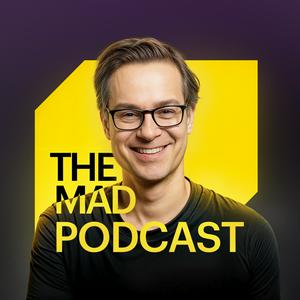
The MAD Podcast with Matt Turck goes deep with the people building AI. Each week, Matt talks with top founders, researchers, and leaders about frontier models, agents, infrastructure, and the companies defining the AI economy. Guests include leaders from OpenAI, Anthropic, Google DeepMind, Hugging Face, Vercel, LangChain, Cloudflare, Snowflake, Datadog, Cerebras, and more.
Matt is a General Partner at FirstMark, a prolific investor in AI and the creator of the MAD Landscape, the industry’s reference map of the AI ecosystem.
New episodes weekly. Transcripts and more at mattturck.com/podcast.
Podcast-WebsiteHöre The MAD Podcast: How AI Gets Built — with Matt Turck, Darknet Diaries Deutsch und viele andere Podcasts aus aller Welt mit der radio.de-App
Hol dir die kostenlose radio.de App
- Sender und Podcasts favorisieren
- Streamen via Wifi oder Bluetooth
- Unterstützt Carplay & Android Auto
- viele weitere App Funktionen
Hol dir die kostenlose radio.de App
- Sender und Podcasts favorisieren
- Streamen via Wifi oder Bluetooth
- Unterstützt Carplay & Android Auto
- viele weitere App Funktionen

The MAD Podcast: How AI Gets Built — with Matt Turck
Code scannen,
App laden,
loshören.
App laden,
loshören.
The MAD Podcast: How AI Gets Built — with Matt Turck: Zugehörige Podcasts
 Deutschland