

Höre diesen Podcast kostenlos in der App: Kostenlos im App Store laden
radio.de
Sleeptimer
Sender speichern
55 Episoden
#55 Karen Boros
12.10.2026 | 29 Min.Collector Karen Boros joins Roland-Philippe Kretzschmar in the latest episode of The Art Bystander podcast. Karen Boros and her husband Christian began by collecting artists of their own generation. As they grew older, they made a deliberate decision to keep following younger artists, eventually those of their son’s generation. Collecting became a way of staying engaged with experiences and ideas beyond their own.
That willingness to remain curious runs through our conversation, recorded in Karen’s home above the Boros bunker in Berlin, after she had taken us through the collection downstairs.
Opened to the public in 2008, the collection occupies a former air-raid shelter that has also served as a prison, a warehouse and a techno club. Its changing presentations bring contemporary art into spaces where the building’s history remains impossible to ignore.
Karen’s experience extends across several parts of the art world. With a background in psychology and art history, she worked in galleries before joining Art Basel in 2005, working in VIP relations for Germany. Alongside building the collection with Christian, she has spent years engaging with other collectors and the relationships through which people find their way into art.
She is candid about how their own decisions happen. “Sometimes I think we should have a strategy, but we don’t,” she tells me. The collection grows through exhibitions, encounters and conversations, supported by longstanding trust in particular galleries.
I wanted to explore how an initial interest becomes a lasting commitment to an artist. What gives you confidence in a practice? What happens when it develops in a direction you hadn’t expected? And what can collectors contribute through the works they buy, the projects they support and the audiences they help artists reach?
Karen makes a point about galleries that deserves more attention: they produce exhibitions that anyone can visit for free. She also speaks about the importance of a work leaving the studio, being seen and entering into discussion. Supporting art involves making those encounters possible.
We talk about Berlin’s changing artistic communities, the challenge of encouraging younger people to collect, and the care involved in opening a private collection to the public. Some people arrive at the bunker knowing the artists; others come for the building and discover the art.
Karen calls them guests. By the end of our conversation, you understand how much work goes into making that word meaningful.
Hosted on Acast. See acast.com/privacy for more information.#54 Lidewij Edelkoort & Philip Fimmano
09.10.2026 | 53 Min.Lidewij Edelkoort on how long trends really take
“Most of the time we only work on the long-term trend. Because the short TikTok things, for a few weeks, are not really interesting in the long run. They just give shape to the big movement. Recently, I showed my books to a publisher and we came to the conclusion that most trends take 20 to 25 years to arrive and to really blossom.”
What happens when we give ourselves permission to play, make mistakes and follow an idea before we know where it will lead? Recorded at Hotel Diplomat in Stockholm, this episode of The Art Bystander brings together host Roland-Philippe Kretzschmar, trend forecaster, publisher and educator Lidewij Edelkoort, and design curator, author and trend analyst Philip Fimmano.
Lidewij Edelkoort on trusting intuition
“I have given my intuition the sole power to give me the messages. So it’s almost something which is working outside my body and my own spirit. It’s going around without me even knowing it is. So it’s completely subconscious, doing its work, and then I just have to say, ‘Thank you very much. This is a very good idea.’ And I do believe that ultimately our intuition is not ours. It’s our common field, which is this big field of experience and soul processes which are around us.”
Their exhibition, INNER CHILD: Playing with Design at Artipelag, provides the starting point for a conversation about childhood, intuition, craftsmanship and the human need to create.
Philip Fimmano on play and the freedom to make mistakes
“Being experimental and taking risks and not being afraid of making mistakes or starting again. These are all the lessons that you learn when you’re playing with toys or even art materials as a child. It’s hard if you’re a perfectionist, like Li and me, but I think through the exhibition we’ve learned how to let go a little bit more. We’re also in a time frame now where everything doesn’t have to be perfect all the time. You can allow yourself to be a bit more playful or express a sense of humour and not take everything so seriously."
Edelkoort explains why the cultural changes she identifies can take 20 to 25 years to become fully established. Fimmano reflects on experimentation, the freedom to begin again and how designers have reconsidered their priorities since the pandemic.
Lidewij Edelkoort on craft and the need for touch
“I believe that people want to speak about craft more as a unique discipline because we need to rekindle it. […] Craft is not just a word like design and art. It’s almost a mentality. […] Our fingers are sort of thirsty for touch. So I guess this is why craft is now so prominent.”
Together, we discuss fashion’s relentless overproduction, the increasingly fluid boundaries between art, craft and design, and how AI might reshape work and education. We also explore Edelkoort’s “age of the amateur”: a possible future in which learning, making and shared interests occupy a larger place in our lives.
Philip Fimmano on the “age of the amateur”
“This is what Li calls the age of the amateur, because we’re going to be embracing hobbies and learning and craft like never before, where it becomes our main focus. In our spare time, so-called free time, we’re going to be investing in learning more, in becoming better at a certain technique or a certain pastime. The idea of cottage industries and doing things at home, and interacting with others, coming together as groups and socialising, all of this is going to be based on this idea that we’re all amateurs and lovers of certain things, and that we then invest ourselves in them like never before.”
INNER CHILD: Playing with Design brings together more than 200 objects by over 100 designers and studios from 23 countries. On view at Artipelag, outside Stockholm, from 10 October 2026 to 11 April 2027.
Hosted on Acast. See acast.com/privacy for more information.#53 Mira Bernabeu
29.09.2026 | 40 Min.What changes when an artist runs a gallery? Recorded inside 2 Mira Archiv in Madrid, this episode of The Art Bystander Podcast brings Roland-Philippe Kretzschmar together with Spanish artist and gallerist Mira Bernabeu, founder of 1 Mira Madrid and an archive space dedicated to conserving, digitising and exhibiting cultural material.
Bernabeu’s career connects the making of images with the practical responsibilities of supporting other artists. From studying psychology and fine art to developing staged photographs with his own family, he has consistently examined the relationships, expectations and systems through which people organise their lives.
That perspective also informs his gallery. We discuss his years co-directing Espaivisor in Valencia, his move to Madrid, and why he decided never to exhibit his own work in his gallery. He explains how he builds connections between exhibitions, what he has learnt from international art fairs, and how he balances artistic conviction with the need to sustain a business.
At the centre of the conversation is the archive. Bernabeu recalls working with Graciela Carnevale to create a facsimile of the Tucumán Arde archive, enabling it to circulate while the original remained in Argentina. He also describes the research and conservation involved in working with artists’ papers, photographs and objects, including the archive of Lea Lublin, and considers how that work will change as more of an artist’s life is recorded digitally.
The conversation becomes personal as Bernabeu reflects on surviving a stroke, becoming more direct, and resisting the expectation that he should abandon his plans. He describes how he protects time for his own practice while establishing an archive that has become a substantial new commitment.
Hosted on Acast. See acast.com/privacy for more information.#52 Michael Sailstorfer
25.09.2026 | 35 Min.In Berlin, a gallery floor is disappearing, one stone at a time.
In this episode of The Art Bystander Podcast, Roland-Philippe Kretzschmar meets Michael Sailstorfer at Galerie Judin’s Mercator Höfe space for a conversation about artistic freedom, physical labour and the uncertainty that runs through the German artist’s latest installation, Pull the Rug.
Around 11,000 paving stones cover the exhibition floor. Every 50 seconds, a worker removes one and feeds it through an opening in the wall. A concealed machine then propels it into an adjoining room, sending the sound and vibration of its impact back into the gallery. Over the course of the exhibition, the floor is gradually removed, exposing the sand beneath.
Born in Bavaria in 1979, Sailstorfer grew up around his family’s stone workshop before studying at the Academy of Fine Arts in Munich and Goldsmiths in London. Now based in Berlin, he has spent more than two decades expanding sculpture through movement, sound, scent and processes of transformation and destruction.
Their conversation moves from his childhood and early ambitions to the pressures of finding success while still at art school, the importance of working directly with materials, and the unpredictable relationship between an idea and its realisation. Sailstorfer explains why he once considered becoming a farmer or an architect, and why the freedom of art ultimately persuaded him to take another path.
Returning to Pull the Rug, they discuss the stability he remembers from his own childhood, the world his children are growing up in, and the uneasy proximity of repetitive labour, contemplation and aggression. A simple act of feeding a stone into a wall becomes the starting point for a wider discussion about machinery, responsibility and what happens when the consequences of our actions are hidden from view.
Recorded at Galerie Judin, Berlin, during Berlin Art Week 2026.
Michael Sailstorfer: Pull the Rug
10 September to 10 October 2026
Galerie Judin, Mercator Höfe, Berlin
Explore Michael Sailstorfer’s work
Exhibition information at Galerie Judin
Hosted on Acast. See acast.com/privacy for more information.#51 Erwin Wurm
22.09.2026 | 37 Min.In this episode of The Art Bystander Podcast, Roland-Philippe Kretzschmar is joined by Erwin Wurm on the occasion of Mind Bubbles & More at Carling Dalenson in Stockholm, running from 22 September to 31 October 2026. One could easily say Erwin Wurm is one of the world's most recognized and respected artists today.
Born in Bruck an der Mur, Austria, in 1954, Wurm has spent more than four decades expanding what sculpture can be, finding material in clothing, furniture, cars, houses and the human body. He originally wanted to become a painter, but found himself placed in a sculpture department. His response was to keep testing the discipline until he could make it his own, eventually returning to painting through works he calls Flat Sculptures.
That resistance to a fixed definition runs through his practice. In the 1992 video 59 Positions, a man and his sweater move through a sequence of poses, making sculpture out of the changing relationship between a body and its clothes. His later One Minute Sculptures invite participants to follow instructions involving everyday objects, adopting positions that can be awkward, funny or difficult to maintain. A sculpture exists briefly through someone's willingness to take part, with balance, embarrassment and the presence of an audience becoming part of the work.
Wurm's distorted objects extend these questions into the things we buy and inhabit. In his Fat Car series, luxury vehicles acquire swollen bodies, exaggerating the excess already associated with them. Fat House turns domestic security into something ungainly and overgrown, while Narrow House compresses his childhood home into proportions that make moving through it uncomfortable. Possessions become a way of examining the expectations attached to success, respectability and belonging.
These works can also be understood against the background of Wurm's childhood in postwar Austria, where the recent Nazi past often remained unspoken and conformity shaped everyday life. The absurd gives him a way of approaching the habits people accept without much examination. Following an instruction, dressing correctly or choosing a particular car becomes material for thinking about how we learn to fit in.
There is a useful connection here with Pierre Bourdieu's account of taste and social distinction: the objects around us communicate class and aspiration, whether or not we intend them to. Wurm makes those objects physically strange enough for their social meanings to become harder to overlook. His humour can leave us wondering why we laughed, and how much of our own behaviour we recognise.
Mind Bubbles & More brings together three-dimensional sculptures and recent Flat Sculptures. The Mind Bubbles borrow the familiar thought-bubble form from comic books while withholding the words or images we expect to find inside. The viewer supplies an imagined thought, continuing Wurm's interest in participation through an encounter that takes place in the mind.
Across sculpture, performance, photography, video and painting, Wurm returns to questions of volume, identity and perception. Wurm’s work is held in major public collections including the Solomon R. Guggenheim Museum, Centre Pompidou, and Walker Art Center. He has received Austria’s Grand State Prize for Fine Arts (2013), the GNMH Award (2021), and an honorary doctorate from the University of Belgrade (2022). He is represented by Thaddaeus Ropac, Lehmann Maupin, and König Galerie.
An introduction to an artist whose work makes the everyday a subject of sustained scrutiny, from the clothes on our bodies to the instructions we follow and the homes we build around ourselves. And be ready for some laughter!
Hosted on Acast. See acast.com/privacy for more information.
Weitere Design Podcasts


Trending Design Podcasts


Über The Art Bystander
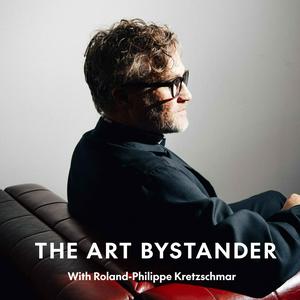
Meet the individuals who drive the art industry today and tomorrow; from artists to gallerists, curators, financial backers, advisors, collectors, and more. Hosted by Roland-Philippe Kretzchmar.More on www.theartbystander.com and www.instagram.com/theartbystander Hosted on Acast. See acast.com/privacy for more information.
Podcast-WebsiteHöre The Art Bystander, 99% Invisible und viele andere Podcasts aus aller Welt mit der radio.de-App
Hol dir die kostenlose radio.de App
- Sender und Podcasts favorisieren
- Streamen via Wifi oder Bluetooth
- Unterstützt Carplay & Android Auto
- viele weitere App Funktionen
Hol dir die kostenlose radio.de App
- Sender und Podcasts favorisieren
- Streamen via Wifi oder Bluetooth
- Unterstützt Carplay & Android Auto
- viele weitere App Funktionen
The Art Bystander
Code scannen,
App laden,
loshören.
App laden,
loshören.
 Deutschland