

Höre diesen Podcast kostenlos in der App: Kostenlos im App Store laden
radio.de
Sleeptimer
Sender speichern
101 Episoden
Raw stems to a show-ready Ableton set — the full workflow
25.08.2026 | 38 Min.I took a folder of raw stems and turned it into a show-ready Ableton Live set — routed, clicked, cued, timecoded, with lyrics — without programming any of it by hand. This episode is the full Pliris workflow, start to finish: upload raw stems, let it analyze key, tempo, and sections, add songs from existing Ableton files, build the setlist, and export a complete Ableton set with samples. Then I play it live with AbleSet to prove it works.
Everything I show (other than the Pro template) works on the free account. The listener-only 14-day trial lives at https://fromstudiotostage.com/pliris/friend — it's not linked anywhere on the site.
★ Support this podcast ★Eight Years In — and the Features I Haven't Shown Anyone
19.08.2026 | 45 Min.Eight years ago today I left a good job, built a membership platform from scratch in two weeks, and hit publish on a one-minute launch video.
This one is a look back — the first digital products and the moment on a roller coaster that rewired how I thought about work. It's also the parts that don't make the highlight reel including wondering if it's still worth all this.
Then I get into where the company actually is now. What it means to run all of this as one person, why every support ticket is becoming an agent instead of a reply, and a walk through the Pliris features I haven't shown publicly anywhere — including the one that took a month to build and is still the hardest thing I've shipped.
Our first-ever Certified Playback Engineer bootcamp starts next week. Five spots, and one is already gone.
Certification bootcamp — fromstudiotostage.com/bootcamp
Listener-only 14-day Pliris trial — fromstudiotostage.com/pliris/friend
Eight years of thanks to the partners who backed this from day one: Oyen Digital, Alclair, Digital Audio Labs, iConnectivity and Ableton.
★ Support this podcast ★How to practically implement redundancy and division of labor
10.08.2026 | 31 Min.Last week I revisited the most controversial video I've ever made and said what I should have said the first time: it isn't can you run everything on one computer — it's should you. This week pays that off. This is the most practical episode we've ever done.
Two listeners asked the same question from opposite ends of it. Jonny said the idea left him feeling "sort of doomed, stuck with my setup." Logan's maxed-out MacBook Pro currently runs the entire show — tracks, vocal tuning, keys, guitar patch changes — and he wants to know whether a powerful computer makes division of labor unnecessary. It doesn't, because the question was never if that computer crashes.
So we walk the diagrams: what actually stops working when one machine does everything and goes down, where to start when the budget is real, which splits cost nothing, and the one question that decides what deserves a backup at all.
Last week's episode: The in-ears video I got wrong — and the one I should have made
Listener-exclusive: a 14-day free trial of a full paid Pliris account — fromstudiotostage.com/pliris/friend. It isn't linked or advertised anywhere on the site; it's for people who listen.
Chapters
0:00 Where we left off last week
1:34 "I run everything on one computer"
2:44 So what happens when it goes down?
3:17 Division of labor, in one diagram
4:10 Redundancy — and what it buys you
5:17 "I feel sort of doomed and stuck"
5:52 Logan's email
7:03 How do you apply this without endless budget?
11:39 "Just play your damn instruments, kids"
12:35 What if you lose autotune?
14:22 Be honest about what your show needs
16:35 What you can split for free
17:26 Split as far as budget allows
18:37 Step one — division of labor
20:46 Step two — redundancy for playback
21:49 It used to be expensive. It isn't now.
24:10 Step three — redundancy for what's crucial
27:24 "What must stay on for the show to go on"
28:25 Zero budget? Start anyway
30:16 Free trial + the annual commitment
31:07 Only you are in charge of your destiny
★ Support this podcast ★The in-ears video I got wrong — and the one I should have made
03.08.2026 | 26 Min.Three years ago I made one of the most controversial videos I've ever put out: What's Wrong With Using Ableton to Run In-Ear Monitors? Looking back at the comments, I think I made the wrong video.
So this week I read the pushback out loud — the people running everything from one machine, the keyboardist who's done ten years and multiple European tours from one Logic session and whose only two failures were a photographer stepping on a power cable, and the guy whose bassist and drummer felt latency he couldn't — and I say what I should have said the first time.
It comes down to two things. It isn't can you, it's should you. And what happens when that computer crashes — which isn't a matter of if.
Next week: how we practically apply redundancy and division of labor when we don't have unlimited budget, aren't traveling, and aren't playing arenas with giant teams.
The video this episode is about: What's Wrong With Using Ableton to Run In-Ear Monitors?
Listener-exclusive: a 14-day free trial of a full paid Pliris account — fromstudiotostage.com/pliris/friend. It isn't linked or advertised anywhere on the site; it's for people who listen.
Chapters
0:00 The video I got wrong
0:53 Why I made it — and why it was off-subject
1:44 The eight reasons, and what they missed
3:15 "I run IEMs through my interface without problems"
4:02 Ten years, one Logic session, European festivals
5:19 It's not can you — it's should you
6:40 The line I should have opened with
7:35 What a stepped-on power cable actually costs you
10:08 When your drummer feels latency and you don't
11:05 What it really takes, part one: 32 inputs
14:20 Ten outputs — and the problem front-of-house can't fix
16:35 The split snake
18:22 Scaling it to a full band
20:10 Why would you manage all of this?
21:32 Where this video ended up: the bootcamps
23:20 It comes down to two things
23:46 A listener-only offer
26:01 Jonny's comment — and what's next week
★ Support this podcast ★How One Gig Became a Music Direction Company | Nate Day & Mat Landry
27.07.2026 | 1 Std. 4 Min.Nate Day and Mat Landry got hired on the same artist in 2021. Neither was a playback engineer. One of them had to become one — and that accident became Eights Creative, a Toronto company now doing music direction and playback systems for artists around the world.
We talk about the path a lot of you are already on: you play an instrument, somebody asks if you can "do playback," and suddenly you're the one who keeps getting called. Nate and Mat break down what music direction actually is — taking an artist's album and deciding what it becomes on a stage — and why playback engineers so often make good MDs.
Then it goes somewhere I didn't plan. I asked how highly skilled, hardworking people avoid getting bitter when the thank-yous go to everyone but the tech. Their answer reframed the job for me: you're not there to serve the artist so much as the person who bought the ticket, paid for parking, and found a babysitter. And the real deliverable isn't a working rig — it's a client who feels confident.
We finish practical: how they run arrangements and approvals, why they'll tell an artist to rent instead of buy, and how one sub drummer and an afternoon of stem exports led them to Bands.
Eights Creative: eightscreative.com · @eightscreative
Chapters
00:00 Intro
02:56 Meet Nate and Mat from Eights Creative
06:09 The ELIO gig and the birth of Eights Creative
11:28 Playback is the skill that gets you the gig
16:17 What music direction actually is
22:13 The playback + MD combo role
25:47 How involved is the artist, really?
28:26 Staying un-jaded when nobody thanks the tech
31:50 "We're not curing cancer" — serving the audience
35:04 Campfires, RTP ports, and why live performance matters
43:43 Inside Eights: creative clients vs. systems clients
48:36 Why we tell artists to rent instead of buy
51:47 How we prep a band before rehearsal
53:54 The Isaiah story — hours of exports, solved
1:00:57 Thanks and wrap
Listeners get a 14-day free trial of Pliris, which we don't offer anywhere else:
https://fromstudiotostage.com/pliris/friend
Join as an annual All Access member and I'll personally help you migrate your entire catalog — first 50 only.
More about Pliris: fromstudiotostage.com/pliris
Docs: fromstudiotostage.com/docs
The Bands app: bands.fromstudiotostage.com
Questions? support@fromstudiotostage.com or @fromstudiotostageig on Instagram.
Mentioned: ELIO · The Beaches · Metric · Toronto Metropolitan University · Ableton Live · iConnectivity PlayAUDIO · DirectOut PRODIGY · Roland SPD · RTP-MIDI
★ Support this podcast ★
Weitere Anleitungen Podcasts
 Krempel & Klartext - Ein Ordnungswelt PodcastAnleitungen, Bildung, Freizeit, Heim und Garten, Kurse
 Die ZeitplanerinAnleitungen, Bildung, Karriere, Wirtschaft
 SonneFreiHaus - Photovoltaik, Speicher, eMobilität und EnergiemanagementAnleitungen, Bildung, Geldanlage, Wirtschaft
 Souverän! Der Podcast für Rhetorik, Wirkung & ÜberzeugungskraftAnleitungen, Bildung, Karriere, Marketing, Wirtschaft
 GELD VERSTEHEN - Struktur und Ordnung in deinen FinanzenAnleitungen, Bildung, Gesundheit und Fitness, Wirtschaft
 Abenteuer Fotografie – Der Podcast für Fotomenschen und FotopraxisAnleitungen, Bildung
 Mission Liebe! Der Single-Podcast mit Nina DeisslerAnleitungen, Beziehungen, Bildung, Gesellschaft und Kultur, Gesundheit und Fitness, Mentale Gesundheit, Selbstverwirklichung
 Utopia – Dein Podcast für NachhaltigkeitAnleitungen, Bildung, Gesundheit und Fitness, Nachrichten
 Arbeitsrecht einfach erklärt - Rechtsanwalt Andreas Martin | Fachanwalt für ArbeitsrechtAnleitungen, Bildung
Trending Anleitungen Podcasts
- Die ZeitplanerinAnleitungen, Bildung, Karriere, Wirtschaft
 Dog It Right | Der Podcast für HundemenschenAnleitungen, Bildung, Freizeit, Hobbys, Natur, Wissenschaft
 Gewaltfreie Kommunikation - Freiheit, Eigenverantwortung & EntwicklungAnleitungen, Beziehungen, Bildung, Gesellschaft und Kultur, Kinder und Familie
- Arbeitsrecht einfach erklärt - Rechtsanwalt Andreas Martin | Fachanwalt für ArbeitsrechtAnleitungen, Bildung
Über Behind the Space Bar
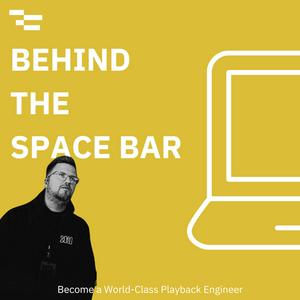
Learn how to become a World-Class Playback Engineer. Hosted by Ableton Live Certified Trainer Will Doggett. New Episodes every Monday @ 10AM ET.
Podcast-WebsiteHöre Behind the Space Bar, Krempel & Klartext - Ein Ordnungswelt Podcast und viele andere Podcasts aus aller Welt mit der radio.de-App
Hol dir die kostenlose radio.de App
- Sender und Podcasts favorisieren
- Streamen via Wifi oder Bluetooth
- Unterstützt Carplay & Android Auto
- viele weitere App Funktionen
Hol dir die kostenlose radio.de App
- Sender und Podcasts favorisieren
- Streamen via Wifi oder Bluetooth
- Unterstützt Carplay & Android Auto
- viele weitere App Funktionen
Behind the Space Bar
Code scannen,
App laden,
loshören.
App laden,
loshören.
Behind the Space Bar: Zugehörige Podcasts
 Deutschland